End of 'Duration of Status': What the New DHS 4-Year Visa Rule Means for OPT Students
The DHS has officially published a final rule eliminating "Duration of Status" (D/S) for F-1 visas. Visas will now have a maximum 4-year limit and the grace period is reduced to 30 days.
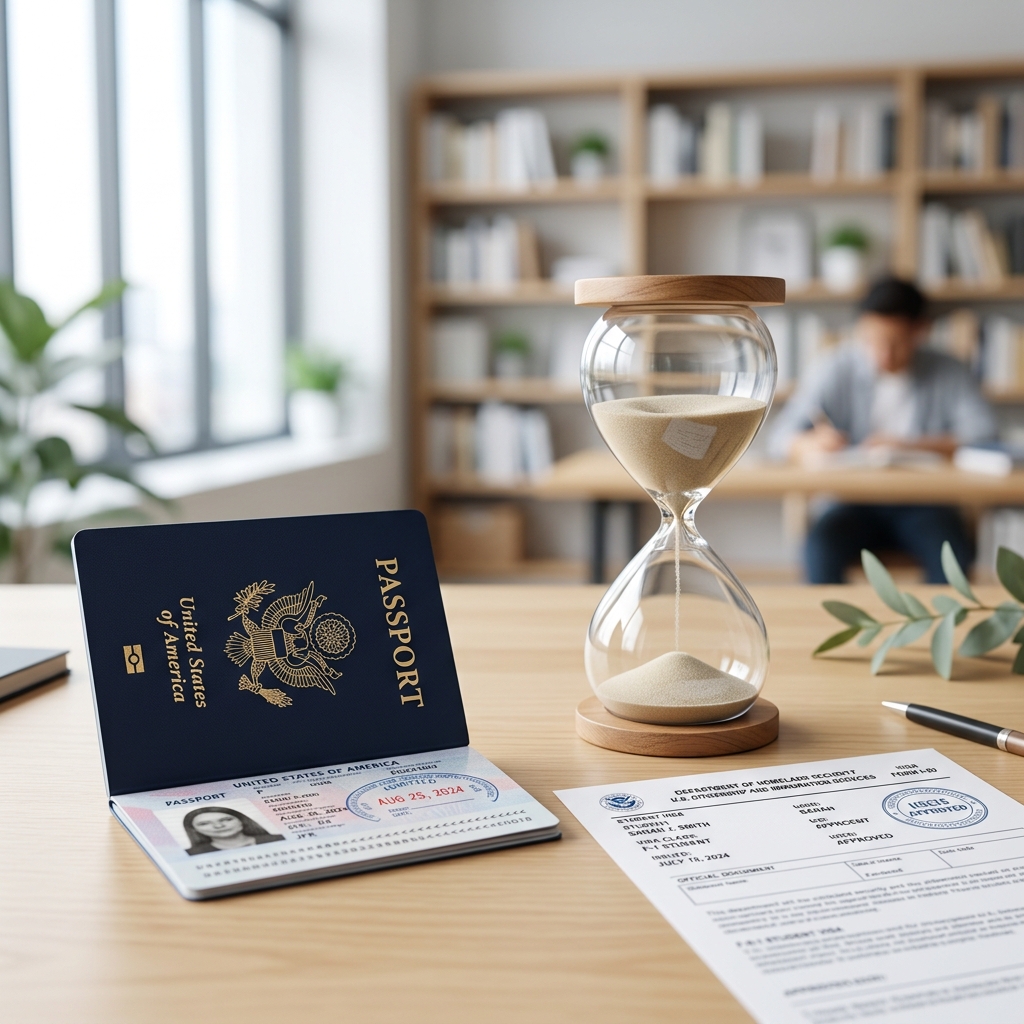
In a massive shift for international education, the Department of Homeland Security (DHS) announced today (July 16, 2026) the publication of a final rule that officially ends the "Duration of Status" (D/S) framework. For nearly 50 years, F-1 students were admitted for an unspecified period as long as they remained enrolled. Now, they face strict fixed admission periods, mandatory federal extensions, and reduced grace periods.
Key Takeaway
The rule goes into effect 60 days after publication in the Federal Register. Current F-1 students will automatically transition to the new system, with their authorized stay capped at a maximum of four years from the rule's effective date.
What Exactly is Changing? The 4 Major Reforms
The "Duration of Status" system allowed students to extend their stay by simply getting a new I-20 from their university's Designated School Official (DSO) when changing levels (e.g., Bachelor's to Master's) or needing more time. The new rule transitions oversight from university staff back to federal authorities.
1. Fixed Admission Caps (4-Year Maximum)
Under the new rule, nonimmigrant students (F visas) will be admitted for the length of their specific academic program, not to exceed a maximum period of four years.
- If your Bachelor's degree takes 4 years, you will be admitted for 4 years.
- If your Master's program takes 2 years, you will be admitted for 2 years.
- If you are in a 5-6 year Ph.D. program, you will initially only get 4 years and must apply for an extension to finish your degree.
2. Mandatory Federal Extensions (EOS)
Previously, if you needed an extra semester to graduate, your DSO just printed you a new I-20. Under the new rule, visa holders requiring additional time to complete a program or transition to a new one (like OPT) must formally apply for an Extension of Stay (EOS) directly through USCIS.
This means submitting an application, paying fees, and undergoing biometric vetting, background checks, and fraud screenings.
3. Reduced Grace Period (60 Days → 30 Days)
The standard 60-day grace period that F-1 students enjoyed after graduation, after OPT ends, or to prepare for departure/transfer schools has been slashed to 30 days.
How this affects OPT students:
- You now have only 30 days after graduation to apply for OPT (if you didn't apply beforehand).
- You have only 30 days after your OPT or STEM OPT expires to leave the country, transfer to a new degree, or transition to a new visa like H-1B.
4. Strict Program Change Restrictions
The rule introduces strict limitations on academic changes to prevent individuals from perpetually enrolling in new courses just to stay in the U.S. Transferring to a lower educational level or a second degree at the same level may face heightened scrutiny during the EOS application process.
The Ultimate 25-Question FAQ: F-1, J-1, & I Visa Scenarios
We've simulated 25 different student and scholar scenarios to comprehensively cover how the new fixed-admission limits affect different visa types, degree levels, and dependents.
1. I am currently an F-1 student in the US. Will my status expire immediately?
No. You will automatically transition to the new fixed-admission system. Your authorized stay is capped at a maximum of four years starting from the effective date of this rule.
2. I am starting a 4-year Bachelor's degree. How does this affect me?
You will be admitted for the exact length of your program (four years). If you graduate on time, you won't need to file for an extension of stay (EOS) for your studies.
3. I am starting a 2-year Master’s program. Do I get 4 years?
No. You will be admitted for the length of your specific academic program (two years). You only get the maximum 4 years if your program takes that long.
4. My Ph.D. program takes 6 years. How do I stay legal?
You will initially be admitted for a maximum of 4 years. Before those 4 years expire, you must file a formal Extension of Stay (EOS) application with USCIS to cover the remaining years of your Ph.D.
5. I am transferring from a community college to a 4-year university. Do I need an extension?
Yes. If your transfer requires you to stay beyond your initial fixed admission date, you cannot just get a new I-20 from your DSO. You must file an EOS with USCIS.
6. I finished my Bachelor's and got into a Master's at the same school. Can my DSO extend my I-20?
No. Changing educational levels requires you to file a formal Extension of Stay (EOS) with USCIS, including biometrics and fees, because you need more time beyond your original fixed admission.
7. I am applying for OPT. Do I need an Extension of Stay (EOS)?
Yes. Because OPT extends your stay beyond your academic program's fixed admission, you must file an EOS alongside your I-765 Employment Authorization Document application.
8. I am currently on STEM OPT (24 months). Does the 4-year rule cut it short?
No. If you are already on STEM OPT, you will transition to a fixed admission date that aligns with the end of your current authorized STEM OPT period.
9. Is the H-1B Cap-Gap extension eliminated?
The automatic nature of Cap-Gap is heavily impacted. Because of fixed admission dates and the 30-day grace period, students may need to file a formal EOS if their status expires before October 1st.
10. What happened to the 60-day grace period?
The standard 60-day grace period for F-1 students after graduation or OPT completion has been permanently reduced to 30 days. You must depart the US or transition status within this window.
11. My spouse is on an F-2 visa. Does the 4-year limit apply to them?
Yes. F-2 dependent visas are tied to the primary F-1 student. Their fixed admission date will be exactly the same as the F-1 student, capped at 4 years.
12. Are F-1 public high school students affected?
F-1 students in public high schools are already restricted to a maximum of 12 months. This rule does not change that limit, but it formalizes their fixed admission period.
13. I am enrolled in an ESL (language training) program. How long can I stay?
Students in language training programs are restricted to a lifetime aggregate of 24 months (2 years) of study, including breaks and vacations.
14. I am a J-1 research scholar. Does the 4-year rule apply to me?
Yes. J-1 exchange visitors (except certain categories) will now be admitted for the length of their program, capped at a maximum of four years, requiring an EOS for longer stays.
15. I am a J-1 Au Pair. Will my program be cut short?
J-1 Au Pairs are admitted for the length of their program (typically one year). You can still apply for the standard extension (up to 12 more months) but must do so through USCIS as an EOS.
16. I am a J-1 exchange student here for one semester. What is my limit?
You will be given a fixed admission date that aligns exactly with the end date of your one-semester program (as listed on your DS-2019).
17. Does this change the J-1 two-year home residency requirement (212e)?
No. The 212(e) home residency requirement remains completely unchanged. You still need a waiver to transition to H, L, or immigrant statuses.
18. I am a J-2 dependent with an EAD. When does my work authorization end?
Your J-2 EAD work authorization will end precisely on your fixed admission date (the same as the primary J-1), unless an Extension of Stay is approved.
19. I am a foreign journalist on an I visa. How long can I stay?
I visa holders (media representatives) are now limited to the duration of their assignment, capped at a maximum of 240 days per admission period.
20. How much will the Extension of Stay (EOS) application cost?
You must pay the standard Form I-539 filing fee (currently $470 for paper, $420 online), plus an $85 biometric services fee.
21. Do I have to do biometrics (fingerprints) every time I extend my stay?
Yes. Moving away from Duration of Status means you must undergo biometric collection and background checks every time you file an Extension of Stay with USCIS.
22. What happens if my fixed admission date expires while my EOS is pending?
If you filed a timely EOS, you are allowed to remain in the US while it is pending (lawful presence). However, your ability to work on campus or participate in CPT/OPT may be paused until approved.
23. Can I travel outside the US while my Extension of Stay is pending?
No. Leaving the United States while an I-539 Extension of Stay application is pending will result in USCIS considering the application abandoned and denied.
24. What happens if I forget to file an EOS and stay past my fixed date?
You will immediately begin accruing "unlawful presence." Accruing more than 180 days of unlawful presence triggers a 3-year ban from the US; over 1 year triggers a 10-year ban.
25. Are there 2-year limits for certain countries or schools?
Yes. Students from countries on the State Sponsor of Terrorism list, or countries with high visa overstay rates (>10%), or those attending non-E-Verify schools, are capped at a 2-year maximum admission instead of 4 years.
Stay Compliant with TrackMyOPT
With grace periods slashed to 30 days and strict caps on your stay, compliance is more critical than ever. TrackMyOPT automatically tracks your unemployment counter, sends deadline alerts, and keeps your SEVIS reporting on schedule so you never accidentally fall out of status.
Protect Your Immigration Status Today
A single mistake—exceeding unemployment days or missing a SEVIS reporting deadline—can ruin your legal presence in the US. TrackMyOPT provides the tools you need to stay compliant.
Related Resources
What Happens If Your OPT Expires?
Your OPT is expiring — what now? Learn how the grace period works, how to extend your stay, and what happens to your F-1 status.
Read GuideThe 90-Day Unemployment Rule
Exceeding 90 unemployment days terminates your OPT instantly. Understand the rules and how days are counted.
Read Guide