The international student’s visual tax guide · 2026
Do F-1 Students on OPT or STEM OPT Need to File an FBAR?
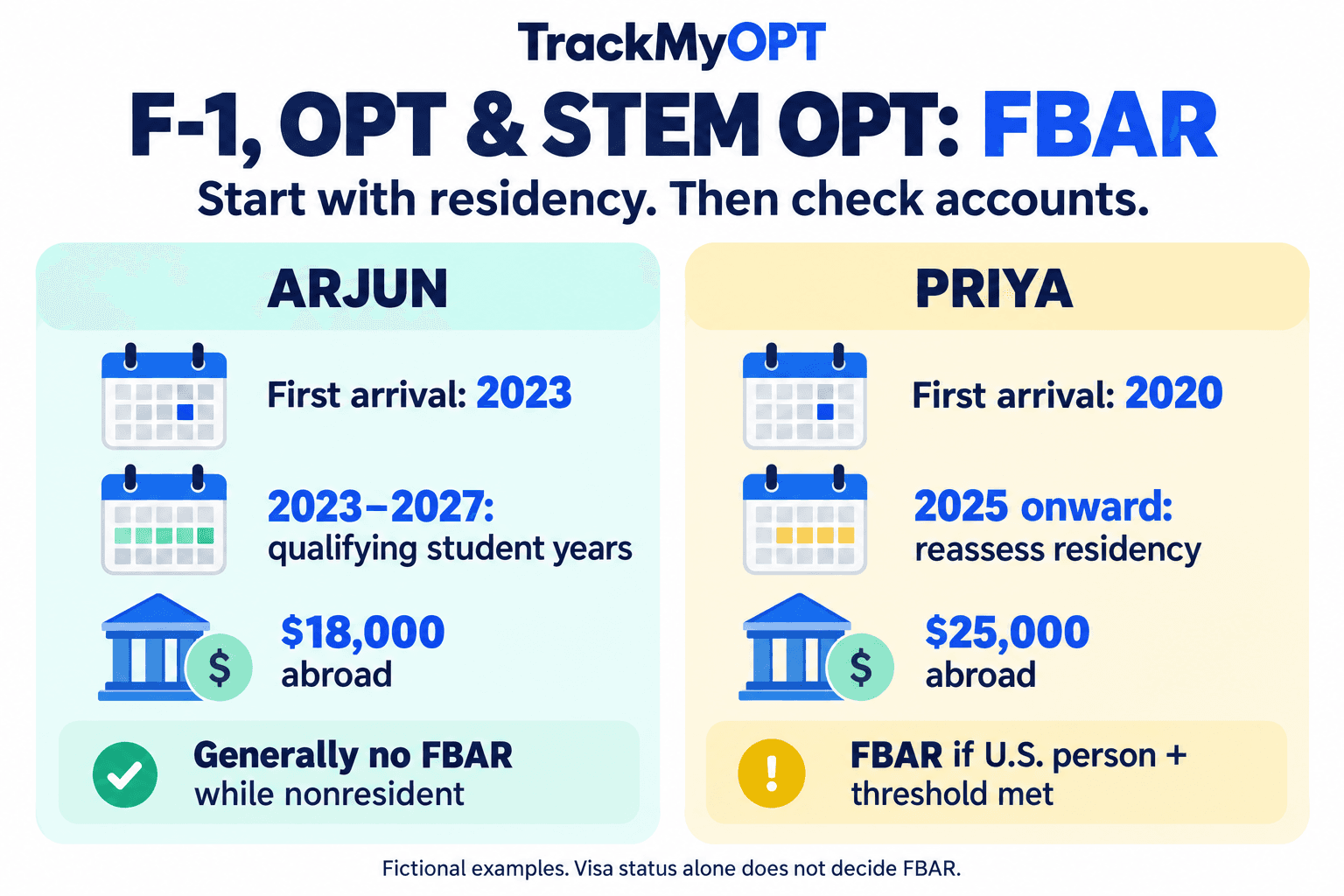
Your friend has $18,000 back home and does not need FBAR. You have $10,500 across three accounts and might need it. The difference starts with residency, not your salary or EAD card.
Quick answer: F1 visa FBAR filing requirements
Many qualifying F-1, OPT and STEM OPT students generally do not need a personal FBAR while they remain nonresident aliens for FBAR purposes. A U.S. person generally must file if they have a financial interest in, or signature authority over, foreign financial accounts whose aggregate value exceeds $10,000 during the calendar year, unless a specific exception applies. FinCEN’s filing rule.
The first five qualifying calendar years usually allow student days to be excluded from the substantial presence test. This is a residency rule, not a blanket F-1 exemption from account reporting or taxes. IRS student rule.
1. What is FBAR, and why does it exist?
FBAR stands for Report of Foreign Bank and Financial Accounts. It is FinCEN Form 114, an annual information report to the U.S. Treasury. It helps authorities identify foreign financial accounts relevant to financial crime and compliance investigations. Filing the report does not itself calculate a tax bill. FinCEN instructions: purpose and definitions.
Think of it as a separate account-reporting obligation. Money saved before coming to the United States can still matter. So can an account that earned no interest. Whether income from that account belongs on a tax return is a different question.
Your FBAR decision path
- 1. Are you a U.S. person for FBAR purposes?
For an individual: U.S. citizenship or residency under the applicable IRC §7701(b) rules. Review the green card test, substantial presence, student day exclusions and first-year choice.
No: generally no personal FBAR.Unsure: have residency reviewed. - 2. Financial interest or signature authority over a foreign financial account?No: no account to report.Yes: combine reportable account values.
- 3. Did aggregate reportable values exceed $10,000 during the calendar year?
Follow FinCEN’s maximum-account valuation instructions. Include every reportable account, not just accounts individually above $10,000.
No: generally no FBAR for that year.Yes: file unless a specific exception applies.
2. Do F-1 students need to file FBAR?
Some do; many do not. For an individual who is not a U.S. citizen, FBAR residency generally follows the resident-alien tests in Internal Revenue Code §7701(b), with the FBAR definition of the United States. A qualifying nonresident student generally falls outside the personal U.S.-person filing requirement. FinCEN’s resident definition.
Before using that conclusion, check earlier visits, changes of status and residency choices. Do not decide from the F-1 visa stamp alone. Also, a U.S. company you own can have its own reporting obligation independently of your personal status.
3. Are OPT and STEM OPT students required to file?
FBAR for OPT students and STEM OPT FBAR filing follow the same basic sequence: determine FBAR residency, identify reportable foreign accounts, then apply the aggregate threshold. Authorized practical training does not, by itself, make a student a tax resident.
OPT and STEM OPT operate within F-1 status. Graduation, earning a full-time salary or receiving an EAD does not restart the five-year count. The IRS distinguishes immigration status from tax residency and discusses authorized student practical training in its guidance. IRS visa and tax-status guidance; Publication 519.
Two different questions: immigration status and tax residency
Immigration status
What permits your stay and work?
- F-1 studies
- F-1 with OPT
- F-1 with STEM OPT
- H-1B after an effective status change
Tax / FBAR residency
Which residency tests apply this year?
- Review all visa and presence history
- Exclude eligible student days
- Apply green card / presence rules
- Review exceptions and elections
Arjun
India · Fictional example- First U.S. arrival
- August 2023
- Visa timeline
- 2023–2024 master’s; 2025 OPT; 2026–2027 STEM OPT
- 2026 tax classification
- Nonresident, assuming qualifying day exclusions and no other residency basis
- Foreign accounts
- $18,000 across personally owned Indian bank accounts
FBAR conclusion: Generally not required during 2023–2027 while nonresident for FBAR purposes.
Arjun worries that his new engineering salary changes the answer. Under these assumptions, his eligible F-1 days remain excluded. His balance exceeds the account threshold, but he has not met the U.S.-person condition. Assume no prior exempt-individual years, green card, citizenship or first-year residency choice.
In 2028 he must reassess. If he remains in the United States, countable days and any valid student exception determine whether he becomes resident. If he becomes a U.S. person and keeps reportable accounts above the threshold, FBAR can become necessary.
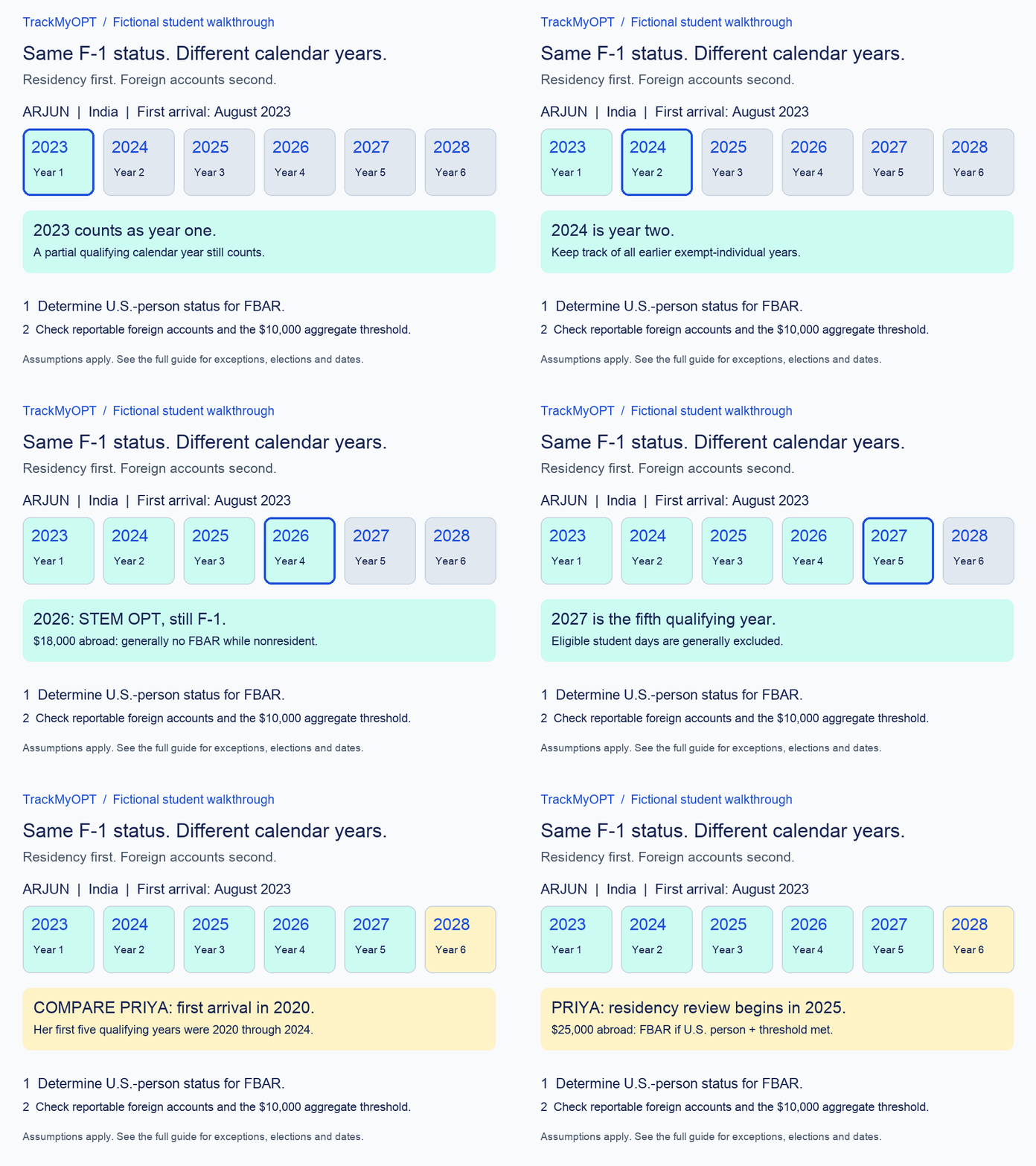
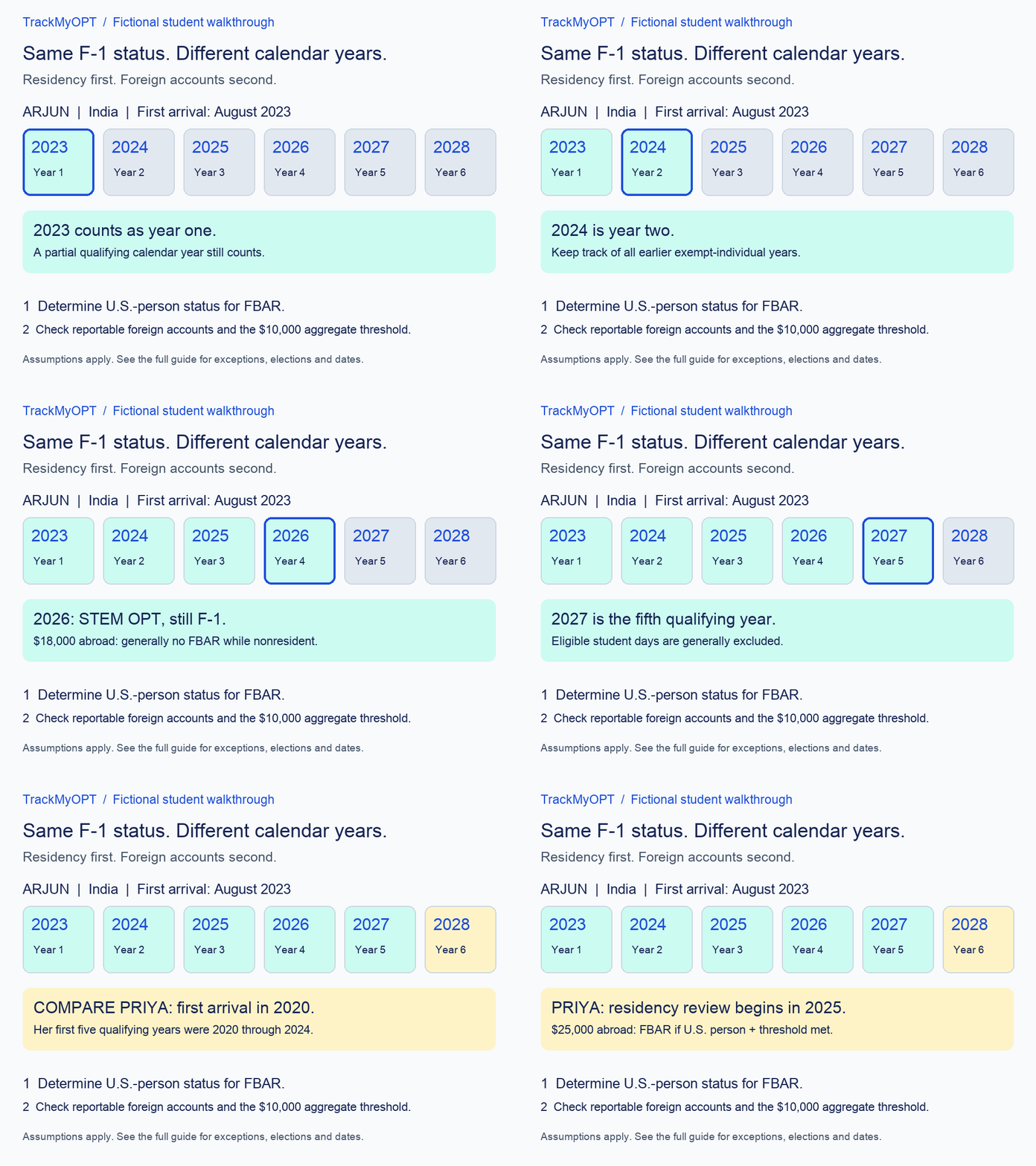
Arjun: five calendar years, then a residency review
- Year 12023Aug arrivalQualifying days generally excluded
- Year 22024F-1 studiesQualifying days generally excluded
- Year 32025F-1 OPTQualifying days generally excluded
- Year 42026STEM OPTQualifying days generally excluded
- Year 52027STEM OPTQualifying days generally excluded
- Year 62028ReassessCount days unless an exception applies
4. What is the five-calendar-year rule?
The phrase “FBAR five year rule” is convenient but misleading: the five-year provision concerns student day exclusions for the substantial presence test. It is not a stand-alone five-year FBAR holiday.
Qualifying students who substantially comply with their status generally exclude eligible days during their first five calendar years. Any part of a qualifying calendar year counts; this is not 60 months measured from arrival. Earlier exempt years in F, J, M or Q categories can matter, including teacher or trainee history. A new degree or a return after time abroad does not simply erase that history. IRS: who is a student.
Michael
Nigeria · Fictional example- First U.S. arrival
- December 28, 2023
- Visa timeline
- 2023–2025 F-1 studies; January 2026 OPT; continuing qualifying F-1 assumed
- 2026 tax classification
- Nonresident under the stated 2026 assumptions
- Foreign accounts
- $12,500 maximum in a personally owned Nigerian savings account
FBAR conclusion: Generally not required while he remains nonresident for FBAR; 2023 still counts as year one.
Michael spent only four days in the United States in 2023. His qualifying calendar years are still 2023, 2024, 2025, 2026 and 2027. The count does not begin with his first full year in 2024. Assume no earlier exempt history or separate residency basis.
He should prepare for a residency review in 2028, even though five full anniversaries after his arrival do not occur until late December that year. Keep the arrival record with annual travel and visa documents.
Michael: four December days still start year one
- Year 12023Dec 28 arrivalQualifying days generally excluded
- Year 22024F-1 studiesQualifying days generally excluded
- Year 32025F-1 studiesQualifying days generally excluded
- Year 42026F-1 OPTQualifying days generally excluded
- Year 52027Year fiveQualifying days generally excluded
- Year 62028ReassessCount days unless an exception applies
5. What does “nonresident alien” mean?
In federal tax terminology, an “alien” is someone who is not a U.S. citizen. A nonresident alien generally does not satisfy the green card or substantial presence test, subject to applicable rules and exceptions. You can rent an apartment, study and work in the United States yet still have this tax classification. IRS nonresident-alien guidance.
“Exempt individual” means certain days do not count toward the presence test. It does not mean exempt from all U.S. taxes. Wage income, required returns and Form 8843 still need attention. Federal tax residency also does not settle every state’s residency rules. IRS explanation of exempt individuals.
6. How does the substantial presence test work?
You generally satisfy the test with at least 31 countable days in the current year and 183 weighted days across three years. First remove days that qualify for exclusion. Then use this formula:
Current-year days + ⅓ of prior-year days + ⅙ of second-prior-year days.
For example, 120 countable days in each year gives 120 + 40 + 20 = 180, below 183. Eligible student days are excluded, not added back at a discounted rate. Travel and status-change dates therefore matter. IRS substantial presence test.
Record physical presence before applying exclusions. Separate “days actually in the U.S.” from “days counted for the test” so your calculations can be checked. If you meet the test later in a year, the residency starting date can reach back to an earlier qualifying presence date; it is not necessarily the 183rd day.
7. What happens after five calendar years?
Recalculate residency each year. Students who can no longer use the ordinary exclusion often become residents if they remain long enough, but year six does not automatically make everyone resident or require FBAR.
Priya
India · Fictional example- First U.S. arrival
- August 2020
- Visa timeline
- 2020–2025 F-1 PhD; 2025 OPT; 2026 STEM OPT
- 2026 tax classification
- Resident in 2026 under the stated presence assumptions
- Foreign accounts
- $25,000 in personally owned Indian savings and deposit accounts
FBAR conclusion: Required for 2026 under these assumptions: U.S. resident, reportable accounts above $10,000, no filing exception.
Priya’s first five qualifying years ended in 2024. Assume she spent all of 2025 in the United States, has at least 183 countable days in 2026, and cannot substantiate continued student exclusion or another applicable exception. She meets the presence test while her immigration status remains F-1.
Her 2025 obligation also deserves review. In the IRS’s comparable full-year F-1 example, residency begins January 1 of the sixth year, although the 183-day test is reached later. With her $25,000 reportable accounts, these assumed facts support FBAR for both 2025 and 2026. IRS residency examples.
Arjun and Priya: same F-1 status, different residency results
| 2026 facts | Arjun · India | Priya · India |
|---|---|---|
| First arrival | August 2023 | August 2020 |
| Visa status | F-1, STEM OPT | F-1, STEM OPT |
| First five qualifying years | 2023–2027 | 2020–2024 |
| 2026 tax residency | Nonresident under these assumptions | Resident under these assumptions |
| Foreign account value | $18,000 | $25,000 |
| FBAR conclusion | Generally not required while nonresident for FBAR | Required if reportable accounts exceed threshold; no exception assumed |
A student exception can sometimes continue beyond five years. The IRS requires facts supporting no intent to reside permanently, substantial immigration compliance, no steps toward permanent-resident status and a closer connection to a foreign country. The student bears the burden of establishing eligibility. It is not enough to say “I still have an I-20.” IRS foreign-student exception.
The separate general closer-connection exception usually requires fewer than 183 actual days in the current year, a foreign tax home and other conditions, typically claimed with Form 8840. Do not confuse it with the student exception. IRS general closer-connection requirements.
Watch the example: arrival year changes the residency review
8. Does switching from F-1 to H-1B change the requirements?
Yes, it can change which days count. H-1B days generally do not receive the student day exclusion. Use the effective status-change date, not just lottery selection, petition filing or an approval issued for consular processing. IRS residency rules.
Daniel
South Korea · Fictional example- First U.S. arrival
- August 2022
- Visa timeline
- 2022–2024 F-1 master’s; 2024 OPT; 2025 STEM OPT; H-1B effective October 1, 2026
- 2026 tax classification
- Generally nonresident for 2026 absent an applicable residency choice or other basis
- Foreign accounts
- $14,000 in personally owned Korean bank accounts
FBAR conclusion: Generally not required for 2026 under these assumptions; potentially required in 2027 or if a residency choice changes 2026.
Assume all his earlier F-1 days qualify for exclusion and he remains in the United States through December 31. October through December contributes 92 countable days. Earlier excluded days contribute zero, so he does not reach 183 for 2026 just because he changed status.
If he stays throughout 2027, he will generally meet the presence test that year. If his reportable foreign balances still exceed $10,000, FBAR generally follows. An eligible first-year choice can change the 2026 analysis; ask a professional before making it. Dates and exceptions control the result. Publication 519: first-year choice.
Daniel: changing status changes which days count
- 2022–2025F-1 → OPT → STEM OPTQualifying student days excluded
- Jan–Sep 2026F-1 STEM OPTEligible days still excluded
- Oct 1–Dec 31, 2026H-1B status effective92 countable days, not 183
- 2027H-1B continuesPresence test likely met if he stays
9. Which foreign bank and financial accounts are reportable?
Common examples include foreign checking and savings accounts, term deposits, brokerage accounts and certain mutual-fund accounts. Some cash-value insurance, annuity and pension arrangements also need evaluation. The account’s location matters more than the bank’s nationality. IRS account comparison.
- An account at a U.S. bank’s branch abroad can be foreign.
- An account at a foreign bank’s branch physically in the United States generally is not foreign for FBAR.
- Joint accounts and authority over someone else’s account can matter.
- A bank account with no income can still be reportable.
If you can direct a bank to move money in a family account, evaluate signature authority even if the money belongs to your parents. Ownership labels, nominee arrangements and specific exceptions can require advice. Joint-account reporting generally uses the full account value, not just your percentage. FinCEN account and authority definitions.
10. How is the $10,000 threshold calculated?
The threshold applies to the aggregate value of reportable foreign accounts, not separately to each account. “Exceeds” means more than $10,000; exactly $10,000 does not cross it. Closing an account or moving money before December 31 does not erase a higher earlier value.
Sara
Brazil · Fictional example- First U.S. arrival
- August 2019
- Visa timeline
- 2019–2023 F-1 degree; 2023 OPT; 2024–June 2026 STEM OPT; August 2026 new F-1 master’s
- 2026 tax classification
- Resident in 2026, assuming at least 183 countable days and no applicable exception
- Foreign accounts
- $4,500 savings + $3,800 term deposit + $2,200 brokerage
FBAR conclusion: Required under these assumptions: combined reportable values reach $10,500 while she is a U.S. person.
Sara assumes three small accounts mean three exemptions. Her first five qualifying years were 2019–2023; a new degree does not restart them. Assume she has met the residency test and the three balances coexist on the same day, after the appropriate currency conversion.
Her combined value crosses the threshold. She reports all three accounts, including the $2,200 brokerage account. We assume no special account or filing exception applies.
Sara: three small accounts cross one aggregate threshold
Each account is below $10,000. Together they exceed $10,000, so all three are reportable, assuming no exception.
For filing, determine each account’s annual maximum in its own currency and convert using the Treasury rate for the last day of that reporting year. Round reported USD amounts up to whole dollars. FinCEN’s instructions direct filers to aggregate maximum account values. If peaks happen on different dates or transfers complicate the total, review those instructions with a professional rather than looking only at one year-end snapshot. FinCEN valuation steps; Treasury exchange rates.
For 2026 accounts, the required December 31, 2026 rate is not yet available as of this article’s October publication date. The student balances here are illustrative USD equivalents, not actual currency conversions.
11. What is the difference between FBAR, Form 8843, Form 1040-NR and Form 8938?
| Form | Purpose | Where it goes |
|---|---|---|
| FBAR / FinCEN 114 | Report qualifying foreign financial accounts when the U.S.-person and aggregate threshold rules apply. | Separately to FinCEN through BSA E-Filing. |
| Form 8843 | Explain eligible presence-day exclusions; generally required for qualifying students claiming them, including without income. | IRS, with the income-tax return or separately if no return is required. |
| Form 1040-NR | Income-tax return for nonresident aliens who meet filing requirements. | IRS; it does not replace FBAR. |
| Form 8938 | Report specified foreign financial assets for covered taxpayers above its separate thresholds. | Attached to the required annual income-tax return. |
Form 8938 can cover more than bank accounts. For a covered unmarried taxpayer living in the United States, thresholds generally exceed $50,000 at year end or $75,000 at any time; filing jointly and living abroad have different thresholds. Certain nonresidents are covered too. If no income-tax return is required, Form 8938 generally is not required. Check its instructions separately. IRS Form 8938 instructions; Form 8843 and instructions.
Watch the residency exceptions: a treaty-based nonresident tax return does not remove FBAR residency if the applicable domestic residency test is met. Spousal elections under §6013(g)/(h) are not considered when determining FBAR residency, while a first-year choice under §7701(b)(4) can matter. Have the exact election reviewed. IRS FBAR manual, U.S. resident rules.
12. How do students file an FBAR if required?
- Confirm the reporting year and residency. Review arrival, departure and effective status-change dates.
- Inventory every reportable account. Gather account numbers, institution names and addresses, ownership and authority details.
- Calculate annual maximum values. Use statements that fairly reflect the maximum and the required exchange-rate method.
- Use FinCEN’s official system. Individuals can file without registering for a BSA account. Start at BSA E-Filing for FBAR.
- Review, submit and save the acknowledgement. A preparer needs the appropriate authorization; keep your records.
FBAR is filed separately from your income-tax return. Keep the required account details and maximum-value records for five years from April 15 following the reporting year. A filed copy helps, but retain supporting statements and conversion calculations too. FinCEN recordkeeping rule.
13. What are the applicable filing deadlines?
| Accounts during | Regular due date | Automatic extended deadline |
|---|---|---|
| 2025 | April 15, 2026 | October 15, 2026 |
| 2026 | April 15, 2027 | October 15, 2027 |
You do not request the automatic FBAR extension. Disaster or other specific relief can change a deadline for eligible filers; check FinCEN’s current notices. As of October 11, 2026, the standard extended deadline for a required 2025 FBAR is only four days away. IRS FBAR deadlines and relief guidance.
Income-tax deadlines are separate. A calendar-year Form 1040-NR filer with wages subject to U.S. withholding generally files by April 15; without such wages, the standard date is generally June 15. Form 8843 follows the applicable 1040-NR due-date rules, including extensions. Use the correct year’s instructions and applicable holiday adjustments. 1040-NR filing instructions; 8843 instructions.
14. What mistakes should international students avoid?
- Counting anniversaries instead of calendar years. Michael’s December arrival still starts 2023.
- Assuming employment changes residency immediately. Daniel must calculate countable days.
- Treating year six as an automatic filing order. Priya’s conclusion depends on presence and exceptions.
- Checking each account against $10,000. Sara must combine reportable values.
- Using only December 31 balances. Higher annual values can matter.
- Confusing tax forms with FBAR. Form 8843, 1040-NR or 8938 does not replace FinCEN 114.
- Ignoring earlier visa history or joint accounts. Your first master’s program may not be the beginning of your relevant history.
If you missed a required report, get advice promptly. Late-filing procedures and potential penalties depend on the facts, including reported income and prior government contact. This guide does not promise penalty relief. IRS delinquent FBAR guidance.
15. When should students consult a qualified tax professional?
Seek a CPA, enrolled agent or tax attorney experienced in nonresident taxation and FBAR when you have prior J/F/M/Q history, more than five qualifying years, a midyear status change, a first-year choice, a joint-return election, a treaty position or a dual-status year.
Foreign pensions, cash-value policies, inherited or family accounts, signature authority, uncertain account peaks and missed filings also justify review. Bring I-94 travel records, status notices, prior returns and Forms 8843, plus account statements. Ask for a separate explanation of your income-tax residency and FBAR residency, including the relevant dates.
No student story can resolve those details for you. The examples show how to ask better questions; they do not substitute for examining your documents.
Frequently asked questions about international students and FBAR
Do F-1 students automatically qualify for an FBAR exemption?
No. Many qualifying students remain nonresident aliens under the applicable residency rules and generally have no personal FBAR obligation. Prior exempt years, status changes, citizenship, green cards and residency elections can change that conclusion. Confirm U.S.-person status for FBAR before checking the foreign-account threshold.
Does STEM OPT start a new five-year period?
No. Starting OPT, a STEM OPT extension or another degree does not restart the qualifying calendar-year count. Review all earlier F, J, M and Q exempt-individual history. A partial qualifying arrival year generally counts as a calendar year, including a December arrival.
Is an FBAR required immediately after my fifth year?
No. Losing the usual student day exclusion means you must reassess residency. Actual countable days, applicable exceptions and elections affect the result. FBAR also requires a reportable foreign-account interest or authority and aggregate values exceeding $10,000, unless a specific filing exception applies.
Do I report accounts if none individually exceeds $10,000?
Yes, if you are a U.S. person and the aggregate reportable foreign-account values exceed $10,000 under the applicable rules. Sara’s $4,500 savings, $3,800 deposit and $2,200 brokerage total $10,500. All three are reportable under her stated assumptions, even though each is below $10,000.
Does filing Form 1040-NR prove I do not need FBAR?
No. A treaty position may allow nonresident income-tax treatment while you remain a U.S. resident for FBAR. The IRS specifically distinguishes these residency rules. Income-tax filing forms, spousal elections and first-year choices must be evaluated separately rather than used as automatic FBAR shortcuts.
When is the FBAR for calendar year 2026 due?
Under the standard rule, April 15, 2027, with an automatic extension to October 15, 2027. You do not request this FBAR extension. Calendar-year 2025 reports have a standard extended deadline of October 15, 2026. Check FinCEN notices for any applicable special relief.
These answers summarize the IRS student rule, presence test, FBAR residency guidance and FinCEN filing requirements. Apply the full rules to your situation.
Your next-step checklist
The core F1 visa FBAR filing requirements are a U.S.-person determination, reportable foreign accounts and an aggregate value exceeding $10,000. Arjun and Michael illustrate qualifying student day exclusions; Priya illustrates reassessment; Daniel illustrates a dated status change; Sara illustrates aggregation.
Use this checklist to identify what needs investigation. Checking boxes does not calculate residency or tell you to file. Nothing is saved or submitted.
For the immigration side of your planning, explore TrackMyOPT’s STEM OPT extension guide and OPT-to-H-1B transition guide. Keep your immigration timeline alongside your tax records so you can review each year with confidence.
Educational disclaimer: This article provides general information, not individualized tax or legal advice. All five students are fictional. Conclusions rely on stated assumptions and rules checked on October 11, 2026. Future rules, filing instructions and relief notices may change. A qualified professional should review your actual residency, accounts, elections and filing obligations.