TL;DR: TrackMyOPT is not a magic bullet. We help you apply faster, track sponsors, and watch your unemployment days. If you are serious about landing a role on OPT, every hour we save you should go back into three things: a resume that proves real qualifications, enough applications to learn whether that resume works, and networking (the one thing almost nobody does).
The market is brutal right now. Roles that used to take twenty thoughtful applications now take hundreds. Every posting you see already has a shortlist forming. If your resume is not in the top slice of what a recruiter actually reads, you will not get a call — not because you cannot do the job, but because they never got far enough to find out.
A keyword is not a qualification
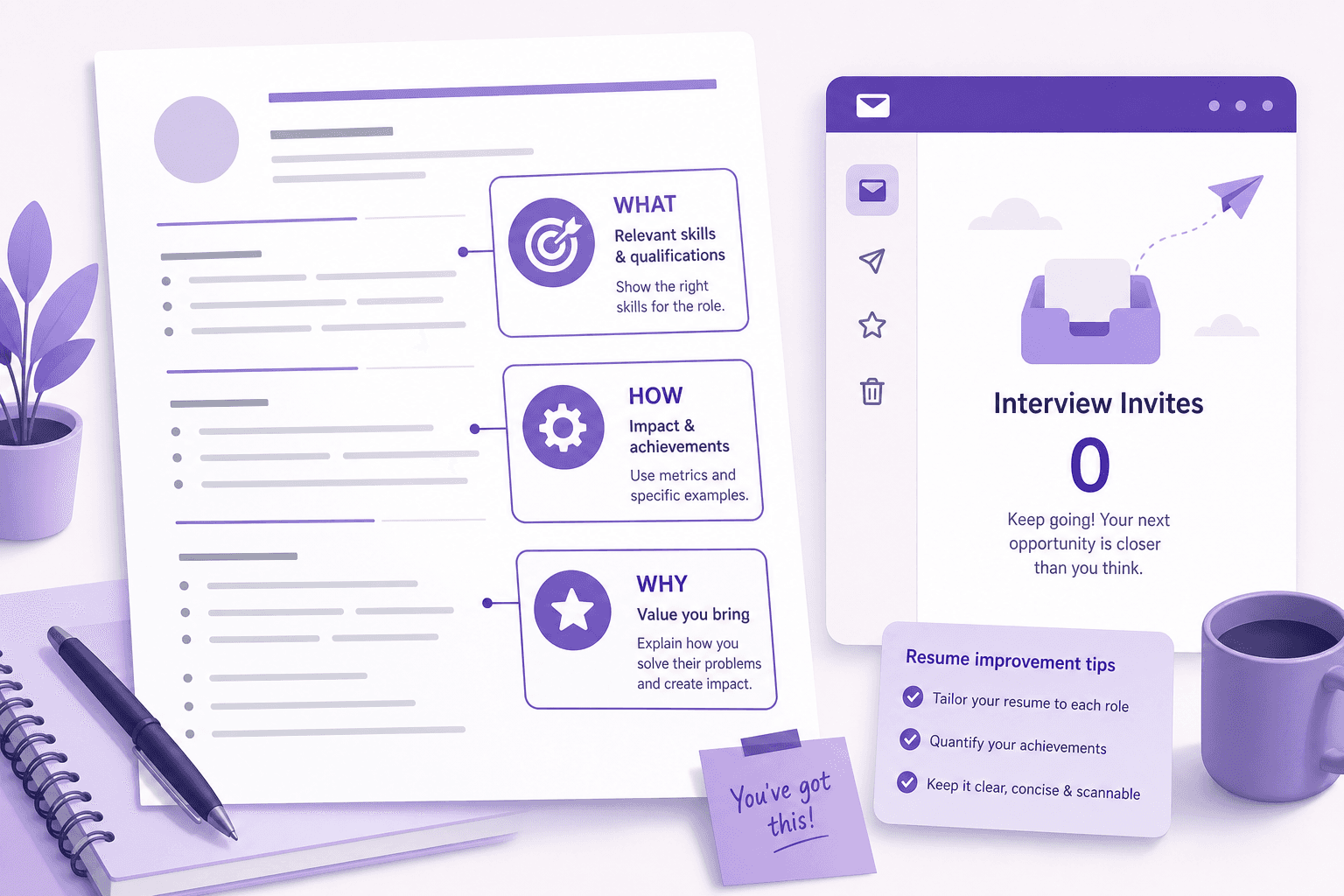
Recruiters are not hunting keywords. They are hunting proof. A real qualification has four parts. Miss one and it does not count:
- What — the exact skill they asked for, in their words
- How — the system, workflow, or thing you built with it
- Why — plain English: what it enabled or fixed
- Where — the job, internship, or project it happened inside
Same work, two ways of writing it:
Does not count: "Architected 12 endpoints across authentication and CRUD. Increased signups 100%." Impressive to another engineer. A recruiter cannot tell which required skills this proves.
Counts: "Built REST APIs in Python with FastAPI and PostgreSQL on AWS so customers could schedule email briefings without asking our team to pull data manually." Their words, a real stack, a reason a non-engineer understands, inside a real role.
What only you can do
The good bullet is not prettier writing. It is more facts. Nobody else has your facts — which is why we cannot generate them for you. Before you add a line, ask:
- Where did you use this, and what were you actually building?
- Who was it for, and what could they do afterward that they could not before?
- Who did you work with or convince?
- If there is a number, what is it measuring and is it real?
If you cannot answer those, leave it off.
What TrackMyOPT actually takes off your hands
- Finding roles at companies with real H-1B filing history — not guessing from the logo
- Saving listings from LinkedIn and Indeed into one tracker with the Chrome extension
- Keeping applications, stages, and follow-ups in one place instead of seventeen tabs
- Counting unemployment days next to your pipeline so compliance does not sneak up on you
- Resume tweaks that mirror wording in a specific posting — the mechanical last mile
All of that is logistics. It buys back hours. It does not put internships on your resume that you never did. Spend the hours on the resume itself and on people who can refer you in.
Rules we see OPT students break
Skills sections do not count as proof
No "where." A recruiter reads them as claims. Prove skills inside a job or project bullet or they are invisible.
Order what they ordered
The job post is the order slip. Impressive adjacent skills — deep framework trivia, obscure libraries, shiny side projects — are not substitutes for what they listed first. Lead with what they asked for in the top third of the page.
Front-load the first bullet
The first bullet under your most recent relevant role is the line most likely to get read. Put your strongest proof there. Do not bury the good stuff at the bottom.
Nothing is implied
TypeScript does not imply JavaScript. Pydantic does not imply Python. GitHub Actions does not imply CI/CD. If they asked for it and you did it, write it. Recruiters will not connect the dots for you.
Vague verbs prove nothing
"Drove operational excellence." "Spearheaded key initiatives." If the sentence would still be true for someone in a completely different job, cut it or rewrite it with specifics.
Interns: half the checklist is not technical
Most intern rubrics want a degree, basic stack knowledge, ability to take feedback, and ability to work on a team. Nearly every intern resume we review proves the first two and gets rejected for missing the second two. Keep education near the top while it is your strongest card.
How to tell if it is working
Count applications per interview. That one ratio tells you whether the resume is the problem.
In this market, one interview per 100–200 targeted applications is a solid outcome for many OPT students — especially cold applications without referrals. If you are far past that with nothing back, more volume will not fix it. Pause. Pick one role you actually want. Pull its requirements. For each line, ask where on your resume a stranger could see you doing it.
Where you cannot find proof, you have two honest options: go build something real and write it down, or do not claim it. We get asked to invent experience constantly. We will not do that for you. The second path is slower and the only one still helping you in five years.
What we are building next
We are wiring sponsor-aware checks and clearer resume feedback into TrackMyOPT so the tool tells you what is missing instead of handing you a meaningless score. We also want to publish side-by-side resume breakdowns — what a recruiter actually sees in the ones that get calls vs the ones that do not.
If this helped, or if it did not, tell us. That is how we pick what to write next.