CPT Lawsuit October 2026: What F-1 Students Should Do About Internships
Universities challenged SEVP’s CPT guidance on October 5. Understand the lawsuit, internship approval, three student examples, and what to confirm with your DSO.

Publication-status note
Verified October 11, 2026: the reviewed filings document a complaint, a motion requesting a preliminary injunction and stay, and a supporting memorandum. They do not establish that the requested relief has been granted. Check your school’s current guidance and any actual court order before changing an internship plan.
Direct answer
On October 5, 2026, four higher-education organizations sued over SEVP’s August CPT guidance. They asked a federal court to pause the disputed interpretation, but the filing itself does not authorize work or reverse a school’s CPT pause. F-1 students should confirm the internship’s academic basis and obtain the required DSO authorization before starting or changing employment.
What You Should Know First
- A complaint explains the plaintiffs’ claims; it is not a court finding.
- The dispute concerns SEVP guidance about when training is integral to an established curriculum, including elective internships for credit.
- Schools may have different program requirements and current processing instructions. MIT’s announced pause is an example of one school’s response.
- CPT and OPT remain different authorizations. A pending CPT lawsuit does not approve an OPT application or restore OPT eligibility.
What happened: August guidance, October lawsuit
The Association of American Universities, NAFSA: Association of International Educators, the Presidents’ Alliance on Higher Education and Immigration, and the Association of Independent Colleges and Universities in Massachusetts filed the lawsuit in the U.S. District Court for the District of Massachusetts on October 5, 2026.
The organizations challenge two ICE Student and Exchange Visitor Program (SEVP) broadcast messages issued on August 12 and August 24. Their complaint argues that the agency unlawfully changed its interpretation of Curricular Practical Training (CPT) eligibility. Those are allegations the court has been asked to evaluate, not conclusions already reached by the judge.
The plaintiffs also filed a motion for a preliminary injunction and stay of agency action on October 5 and a supporting memorandum on October 6. A motion asks the court to act. Its filing date should not be reported as the date a policy was blocked.
This guide is for enrolled F-1 students planning internships or co-ops, students whose schools have paused a CPT request, and students considering how practical training affects later OPT. It explains the news and gives you questions to take to the DSO; it cannot decide whether your particular internship qualifies.
Sources: October 5 CPT lawsuit and October 6 supporting memorandum; Filed complaint: Association of American Universities v. DHS; Motion requesting a preliminary injunction and stay of agency action
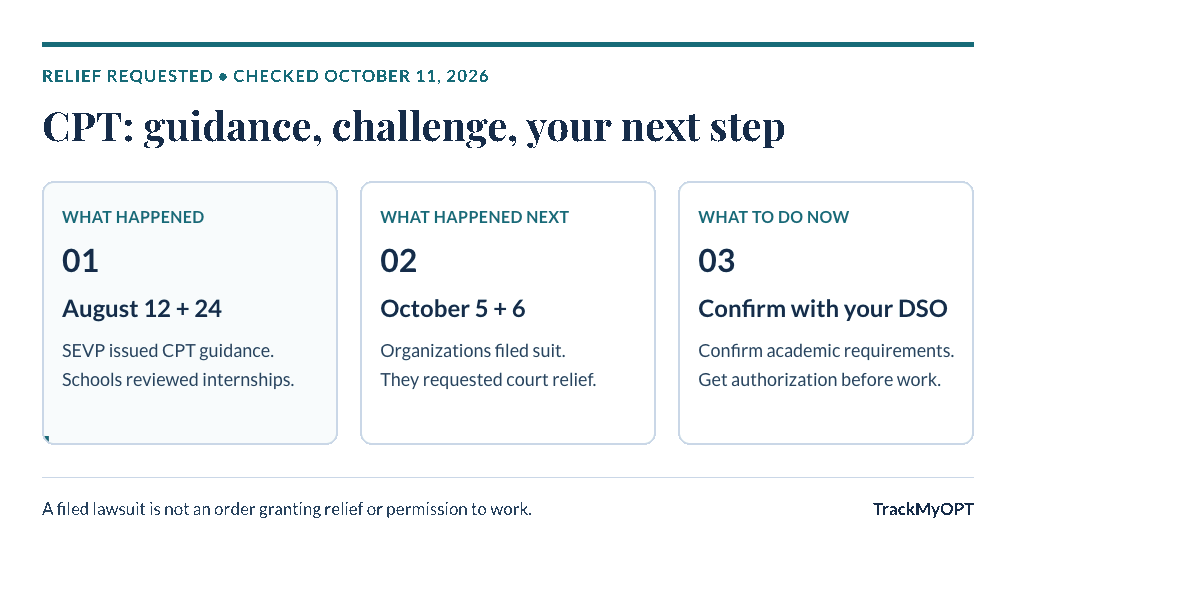
- 1. What happened: SEVP issued guidance on August 12 and August 24.
- 2. What happened next: organizations filed suit and requested relief on October 5.
- 3. What applies now: confirm your school’s guidance and DSO authorization.
- 4. What comes next: read any actual court order and the school’s resulting instructions.
What is the CPT eligibility dispute?
The regulation describes CPT as practical training integral to an established curriculum. The central dispute is how SEVP interprets that relationship, particularly for an internship taken for academic credit when not every student in the degree program must complete it.
According to the complaint, the August messages treat qualifying training as mandatory for every student in the degree program. The plaintiffs argue this improperly excludes credit-bearing elective training and departs from a longstanding approach without the required process. Readers should distinguish the agency interpretation, the plaintiffs’ argument, and a later judicial ruling.
For a student, the difference is concrete. “My internship is related to computer science” answers a subject-matter question. “My degree’s curriculum requires or academically integrates this training, and my DSO has authorized it” addresses additional requirements. A relevant job offer or a course registration alone is not a reliable permission slip to work.
Ask the school which published curriculum provisions, employer arrangements, faculty supervision, and enrollment records it needs for your program. You should not reconstruct the school’s eligibility policy from social-media examples or another university’s checklist.
Sources: 8 CFR 214.2(f)(10): practical training regulations; Filed complaint: Association of American Universities v. DHS; October 6 memorandum supporting requested court relief
What the lawsuit changes today, and what remains unresolved
The lawsuit creates a formal challenge and a request for interim relief. It does not itself approve new CPT, reactivate a paused school process, or grant permission to extend a previously authorized internship. In the materials reviewed for this guide, the requested relief remains a request; this article does not claim an injunction has been granted.
A future order might address particular messages, particular enforcement actions, or particular parties. If an order is issued, read its scope and effective timing rather than assuming that a headline applies to every school and student. Your school then needs to explain how it is implementing the development for its programs.
Keep this dispute separate from litigation over F-1 Duration of Status. A court action affecting fixed admission periods does not automatically resolve the academic requirements for CPT. Similarly, the proposed OPT fees are a separate rulemaking, not a ruling in this CPT case.
The useful question today is specific: “Does my school currently authorize this exact training, for these dates and this employer, under its current instructions?” An answer to that question is more useful for next Monday’s internship than a prediction about the lawsuit’s eventual outcome.
Sources: Motion requesting a preliminary injunction and stay of agency action; October 6 memorandum supporting requested court relief
Three fictional students: required co-op, elective credit, and existing CPT
The following people are fictional and their cases illustrate questions to ask, not eligibility decisions or accounts of real customers. No example should be used to override your DSO’s instructions.
Aisha’s engineering degree includes a co-op required for every student. She should gather the curriculum requirement, employer offer, dates, and school-requested documentation. That academic requirement may be relevant under the disputed guidance, but she still needs the school to evaluate all CPT conditions and issue authorization before starting. A mandatory co-op does not bypass the approval process.
Luis has an optional data-science internship and can earn course credit for it. This is the kind of distinction at the center of the complaint: the training may carry academic credit without being mandatory for every student in the degree. Luis should not tell the employer that the lawsuit has made him work-authorized. He should ask his DSO for a written decision and discuss a contingent start date.
Hana already has a fall CPT authorization and wants to add a second employer or extend into winter. Her prior authorization does not automatically cover a new employer or period. She should confirm the scope of the existing I-20 authorization and whether her school requires a new review. A pending court request does not fill a gap between authorized dates.
Each student should keep the academic question and the work-authorization question visible. Faculty may confirm an internship’s educational value; the DSO handles the CPT authorization process. A conversation with a professor or recruiter does not replace the required immigration documentation.
Sources: 8 CFR 214.2(f)(10): practical training regulations; Filed complaint: Association of American Universities v. DHS; MIT notice on its pause in certain CPT authorizations
Why one university’s CPT pause is not every school’s policy
MIT’s International Students Office announced a pause on certain new or pending requests involving experiences not required of all students in a degree program and said it would contact students already issued fall CPT authorization to discuss options. That is direct evidence of one institution’s response, not a nationwide rule that every internship was canceled.
Your school may have different degree structures, supporting documents, and current instructions. Ask whether its guidance affects pending requests, existing authorizations, extensions, or only certain types of training. Save the written reply and any replacement I-20; do not assume a general campus announcement resolves the facts of your own authorization.
If you have already begun an internship and receive a concerning notice, promptly contact the DSO and, when appropriate, qualified immigration counsel. Explain your actual authorization dates and any employer or program changes. Avoid drawing a status conclusion from someone else’s experience on a forum.
Sources: MIT notice on its pause in certain CPT authorizations
Keep CPT, pre-completion OPT, and post-completion OPT separate
CPT is authorized through the school for qualifying curricular training. OPT generally involves a DSO recommendation followed by a USCIS employment-authorization application. They have different approval steps and timing. A CPT delay does not make OPT instantly available, and a pending initial OPT application is not permission to begin the internship.
The regulation also makes students who receive one year or more of full-time CPT ineligible for post-completion OPT. Part-time CPT does not trigger that same full-time threshold. If you have multiple CPT periods, ask the DSO to review the exact authorizations and cumulative history rather than using a rough month count.
Pre-completion OPT may be worth discussing when CPT is unavailable, but it has its own eligibility, filing process, work-hour limits, and effect on the OPT time available after graduation. Treat it as a question for a timely planning discussion, not a workaround that automatically preserves the same start date.
For example, Luis can ask whether a different lawful authorization fits his academic and immigration situation. He should also ask how long that process might take and what tradeoffs it creates for post-graduation OPT. He should keep the employer informed that any start remains contingent on valid authorization.
Sources: 8 CFR 214.2(f)(10): practical training regulations; Optional Practical Training for F-1 Students
What to ask your DSO before an internship start date
Send a short request with the employer name, proposed duties, weekly hours, work location, dates, academic course or program requirement, and any existing authorization. Use the school’s secure process for personal documents. Do not upload private immigration records into a public legal-news discussion.
Ask the DSO to distinguish the academic evidence it needs from the immigration authorization it can issue. If the request is paused, ask which condition is unresolved and whether the office has a written update students can share with employers. This makes the employer conversation practical without promising a court outcome.
If a court order appears, ask for a fresh school update before assuming that a prior pause ended. Save the official order or a link, the school’s interpretation, and the resulting decision for your request. TrackMyOPT can help organize your later OPT timeline and case milestones; it does not issue CPT authorization.
Your next step should follow the document that governs your situation: current school instructions and valid authorization now, then any applicable court order and revised instructions later. Keeping those steps separate makes the news easier to understand and your internship plan easier to explain.
Sources: 8 CFR 214.2(f)(10): practical training regulations; MIT notice on its pause in certain CPT authorizations
- Does this exact training satisfy our degree’s current academic requirements?
- Do the August messages affect this request or an existing authorization?
- Which employer, location, hours, and dates will the authorization cover?
- What must be issued before I can begin or change the internship?
- How does my full-time CPT history affect later OPT eligibility?
Your Action Checklist
Common Mistakes to Avoid
- Reporting a requested injunction as a granted injunction.
- Assuming course credit or a related job automatically authorizes CPT.
- Treating one university’s processing pause as every school’s policy.
- Assuming a prior CPT authorization covers new dates or a different employer.
- Assuming an unpaid internship needs no authorization review.
See your OPT timeline in one dashboard
Track processing milestones, unemployment days, and deadlines alongside your case status.
Also see USCIS case status tracker features
Data and methodology note
Verified against the linked filings and institutional notices on October 11, 2026. Plaintiff arguments are identified as arguments; no granted CPT injunction is asserted. Aisha, Luis, and Hana are fictional teaching examples. No applicant data is used. The cover is AI-generated conceptual art.
Frequently Asked Questions
Did the October 5 CPT lawsuit block SEVP’s guidance?
The reviewed filings establish that the plaintiffs requested an injunction and stay. Filing that request does not itself block guidance. Check for an actual court order and your school’s current instructions.
Can I start CPT while the lawsuit is pending?
A lawsuit does not authorize employment. Obtain the required DSO authorization for your particular employer and training period before starting, and follow your school’s current instructions.
Does academic credit guarantee CPT approval?
No. Credit-bearing elective training is central to the dispute, but a course enrollment or relevant internship offer alone does not replace the school’s eligibility review and authorization.
Is every university pausing CPT?
This guide does not establish a pause at every school. MIT announced a pause in certain authorizations. Check your own school’s current policy and how it applies to your degree and request.
Does full-time CPT affect later OPT?
Under the practical-training regulation, one year or more of full-time CPT makes a student ineligible for post-completion OPT. Review your exact authorization history with the DSO; part-time CPT has a different effect.
Can I use pre-completion OPT instead of CPT?
Possibly, if you meet its separate requirements. Discuss eligibility, USCIS filing and approval timing, work-hour limits, and the effect on remaining OPT with your DSO. It is not an automatic substitute.
Official Sources
Rules can change. We checked this guide against the primary sources below; always open the current form instructions or agency page before acting.
- October 5 CPT lawsuit and October 6 supporting memorandum — Association of American Universities (a plaintiff)
- Filed complaint: Association of American Universities v. DHS — Plaintiffs, U.S. District Court for the District of Massachusetts
- Motion requesting a preliminary injunction and stay of agency action — Plaintiffs, U.S. District Court for the District of Massachusetts
- October 6 memorandum supporting requested court relief — Plaintiffs, U.S. District Court for the District of Massachusetts
- 8 CFR 214.2(f)(10): practical training regulations — Electronic Code of Federal Regulations
- MIT notice on its pause in certain CPT authorizations — MIT International Students Office
- Optional Practical Training for F-1 Students — USCIS
Keep Reading
Written by Vinay Kumar
Vinay is a content writer at TrackMyOPT who specializes in immigration guidance for international students. All content is researched using official USCIS, SEVP, and Department of Labor sources and reviewed for accuracy by the TrackMyOPT team, which includes former F-1 students who navigated OPT, STEM OPT, and H-1B transitions firsthand.