OPT Fee Proposal 2026: What the $70,000 and $30,000 Fees Would Mean
DHS proposed large OPT fees on October 8. Learn who would pay, how STEM OPT could be affected, the comment deadline, and what students should do now.

Publication-status note
Verified October 11, 2026: this is a proposed rule, not an effective OPT fee requirement. The main public-comment deadline is November 9, 2026; the separate information-collection deadline is December 7. No final-rule effective date has been established by this proposal.
Direct answer
DHS’s October 8 OPT fee proposal would require an SEVP-certified school to pay $70,000 before an initial OPT recommendation and $30,000 for subsequent OPT after the initial fee has been paid. The proposal includes STEM OPT. These amounts are not current student filing fees. Keep following today’s OPT rules and deadlines while checking your school’s guidance and the official rulemaking docket.
What You Should Know First
- The proposal places the government-payment obligation on the school; it does not create a $70,000 bill payable today by every student.
- A STEM recommendation after a future effective date could trigger $70,000 if no initial fee was previously paid under the proposed system.
- An employer change alone would not trigger this proposed fee. A new OPT recommendation is the relevant event.
- A comment deadline is not an effective date. The proposed transition would begin 60 days after publication of a future final rule.
What happened on October 8, and who should read this?
The Department of Homeland Security published “Optional Practical Training Fees” as a notice of proposed rulemaking on October 8, 2026. This guide is for F-1 students preparing for graduation, students already working on post-completion OPT, and students planning a STEM OPT extension. It also helps families interpret headlines without turning a possible future cost into an immediate payment instruction.
A proposal starts a rulemaking process. It does not, by itself, change your current Employment Authorization Document (EAD), approve a new application, or create a payment requirement. The useful next step is to identify your next real immigration milestone: program completion, a DSO recommendation, an I-765 filing, or an EAD expiration.
Keep three dates separate when reading the news: the proposal’s publication date, its public-comment deadline, and any later final-rule effective date. Only the third would tell you when a finalized requirement starts. The final text could differ from the proposal, so a headline is not enough to plan a filing.
Sources: Optional Practical Training Fees: October 8 proposed rule, sections V–VI
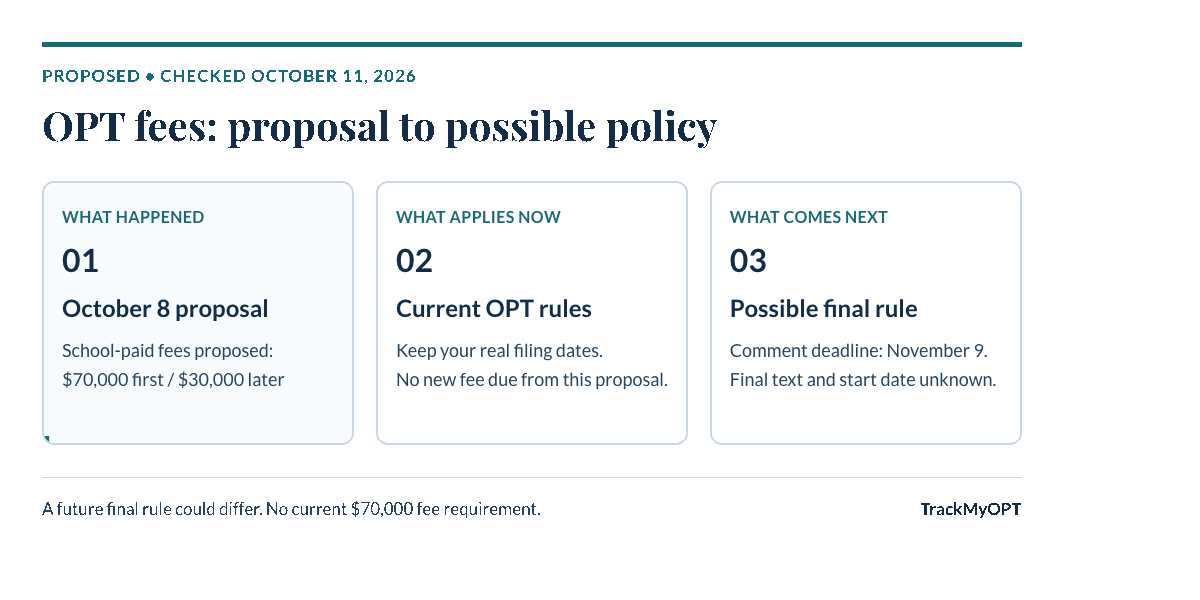
- 1. What happened: DHS published the proposal on October 8, 2026.
- 2. What applies now: existing OPT rules and your actual filing deadlines.
- 3. What comes next: comments, agency review, and a possible final rule.
- 4. Only if finalized: check the final effective date and transition language.
Who would pay the $70,000 OPT fee?
Under the proposed approach, the SEVP-certified educational institution would make the government payment before its designated school official (DSO) recommends OPT in SEVIS. The first fee is proposed at $70,000. Another OPT recommendation would be subject to $30,000 after the student’s initial fee has been paid under this system.
The first recommendation could be for pre-completion OPT, post-completion OPT, or a STEM OPT extension. “Initial” in this fee proposal should not be read as a guarantee that every first STEM extension costs only $30,000. The proposed transition matters for students who participated in OPT before this fee system existed.
The proposal identifies the school as the payer to the government. It does not tell you what your own school will ultimately offer or what the full financial arrangements would be if a rule becomes effective. Ask the university for its written position before making tuition, loan, enrollment, or job decisions based on a guessed cost.
Sources: Optional Practical Training Fees: October 8 proposed rule, sections V–VI; OPT fee proposal: original agency text and proposed transition provision
- Proposed payer: the SEVP-certified school.
- Proposed first fee: $70,000 before the DSO’s recommendation.
- Proposed later fee: $30,000 after a prior initial fee payment.
- Current action: verify legitimate USCIS filing instructions; do not pay a new fee from a social-media link.
Three fictional students: graduation, STEM OPT, and pre-completion OPT
These examples are fictional planning scenarios, not predictions, legal determinations, or stories about TrackMyOPT customers. They use the proposal as written to show which facts would matter if it were finalized without changes.
Priya is finishing a master’s degree in December 2026 and preparing her first post-completion OPT application. Today, she should obtain her DSO recommendation and follow the current filing window. If a future final rule takes effect before her recommendation, her school would need to evaluate the new requirement. She should not invent an effective date or miss a valid filing window while waiting for news.
Daniel already holds a post-completion OPT EAD and plans to seek STEM OPT in spring 2027. His school has never paid an initial fee under the proposed system. The transition provision would require $70,000 for a recommendation on or after the eventual effective date, including a STEM recommendation. His existing EAD does not mean that every future recommendation is automatically exempt.
Mei is considering pre-completion OPT now and post-completion OPT later. In a hypothetical future system where her school pays $70,000 for her first recommendation, the proposed subsequent fee could add $30,000 for the later recommendation. The combined $100,000 describes two school payments in that scenario, not an automatic invoice to Mei today.
For all three students, the practical task is the same: document the next recommendation and filing dates, ask the school what it can confirm, and keep current compliance obligations separate from conditional financial planning.
Sources: OPT fee proposal: original agency text and proposed transition provision
What would trigger a fee, and what would not?
The proposed trigger is the school’s OPT recommendation, rather than each job change. For example, Daniel moving between employers during an already-authorized OPT period would not, by that fact alone, cause this new proposed payment. He would still need to follow the employment-reporting rules that apply to his current authorization.
Do not combine this OPT proposal with the separate H-1B fee proposal. OPT recommendations and an employer’s H-1B petition are different processes, with different proposed payers and triggers. A recruiter discussing H-1B sponsorship cannot confirm what your university will do about an OPT recommendation.
Paying a fee would not replace eligibility requirements or guarantee employment authorization. A student would still need to satisfy the rules governing the requested training and application. Conversely, the news does not give a pending initial OPT applicant permission to start work early.
Sources: Optional Practical Training Fees: October 8 proposed rule, sections V–VI; Optional Practical Training for F-1 Students; Fee for Certain H-1B Petitions (proposed rule, 91 FR 54817)
What could happen next? Read the transition carefully
The proposal would have a final rule take effect 60 days after publication of that final rule. That is a proposed transition period, not a countdown starting on October 8. There is no confirmed implementation day to calculate from the proposal alone.
Its transition language would apply the initial fee to a recommendation dated on or after the future effective date when an initial fee has not previously been paid. A prior OPT history by itself would not necessarily protect a later STEM recommendation. Ask about the date of the recommendation, the history of fee payment under the new system, and the final transition text.
Possible next steps include reviewing public comments, publishing different final provisions, or leaving the proposal unfinalized. Any later litigation would need to be assessed separately. These are possible process outcomes, not a forecast that one particular outcome will occur.
For a useful planning discussion, prepare two columns: obligations you have today and decisions that depend on future official action. Put current I-765 and EAD dates in the first column. Put school funding decisions and possible new fee requirements in the second.
Sources: Optional Practical Training Fees: October 8 proposed rule, sections V–VI; OPT fee proposal: original agency text and proposed transition provision
November 9 comment deadline: how to contribute useful feedback
The published notice sets November 9, 2026 as the deadline for comments on the rule itself. December 7, 2026 is a separate deadline concerning the information collection under the Paperwork Reduction Act. Do not substitute the later date for the main rule-comment deadline.
If you choose to comment, open the official Federal Register notice and use its Regulations.gov link for docket ICEB-2026-0100. Explain a concrete effect and the provision you are discussing. For example, describe how a prospective recommendation requirement could affect a graduation-to-training plan, and support financial claims with figures you can substantiate.
Comments can become public. Use a generalized account of your situation and remove unnecessary identifying details, receipt numbers, passport details, and personal documents. A public comment is not a private immigration case inquiry. You can also ask your university how it plans to provide institutional feedback.
Submitting a comment does not extend your status, pause an EAD expiration, or change an OPT filing deadline. Treat it as an optional contribution to rulemaking while continuing your own application preparations.
Sources: Optional Practical Training Fees: October 8 proposed rule, sections V–VI
A practical plan for the coming week
Start with a short appointment or written request to your international student office. Include your program end date or EAD expiration, the kind of OPT you expect to request, and the month you anticipate asking for the recommendation. Ask which dates and requirements the office can confirm today.
Keep a private folder with your I-20s, EAD, notices, and communications. TrackMyOPT can help you organize your existing OPT timeline and case-status milestones; it cannot promise a fee exemption or a university funding decision. The school and, when needed, qualified immigration counsel remain the right sources for your individual plan.
If a new official document appears, check its legal status and effective-date section before changing your plan. A comment extension, a press release, and a final rule are different events. The next meaningful update to this guide should identify the document, date, and practical consequence.
Your Action Checklist
Common Mistakes to Avoid
- Treating proposed amounts as fees due today.
- Assuming every STEM recommendation would cost only $30,000.
- Assuming an existing EAD exempts all later OPT recommendations.
- Counting 60 days from October 8 as an implementation date.
- Confusing a school-paid OPT recommendation fee with an employer’s H-1B petition fee.
See your OPT timeline in one dashboard
Track processing milestones, unemployment days, and deadlines alongside your case status.
Also see USCIS case status tracker features
Data and methodology note
Sources were checked October 11, 2026. Priya, Daniel, and Mei are fictional; their examples illustrate conditional planning and do not determine eligibility or predict final policy. The cover is AI-generated conceptual art.
Frequently Asked Questions
Is the $70,000 OPT fee in effect now?
No. As verified October 11, 2026, the October 8 notice is a proposed rule. It does not establish a current $70,000 OPT payment requirement.
Who would pay the proposed OPT fees?
The proposal requires the SEVP-certified school to pay the government before its DSO recommends OPT. It does not establish each university’s future financial arrangements with students.
Would STEM OPT always have a $30,000 fee?
No. Under the proposed transition, a recommendation on or after a future effective date could require $70,000 if no initial fee has been paid under the system. The $30,000 amount applies to subsequent OPT after the initial fee payment.
Would changing OPT employers trigger another fee?
The proposal says an employer change alone is not the trigger. The school’s decision to issue an OPT recommendation is the relevant event. Existing reporting requirements would still apply.
When is the OPT fee proposal comment deadline?
The published rule-comment deadline is November 9, 2026. The separate information-collection deadline is December 7, 2026. Verify the official notice for any later extension.
Should I delay my OPT application because of this proposal?
Continue planning under current rules and confirm your filing window with your DSO. The proposal does not pause your application deadlines. Seek advice about your individual situation before changing a valid plan.
Official Sources
Rules can change. We checked this guide against the primary sources below; always open the current form instructions or agency page before acting.
- Optional Practical Training Fees: October 8 proposed rule, sections V–VI — DHS / ICE, Federal Register
- OPT fee proposal: original agency text and proposed transition provision — DHS / ICE
- Optional Practical Training for F-1 Students — USCIS
- STEM OPT Hub — Study in the States
- Fee for Certain H-1B Petitions (proposed rule, 91 FR 54817) — U.S. Department of Homeland Security / USCIS
Keep Reading
Written by Vinay Kumar
Vinay is a content writer at TrackMyOPT who specializes in immigration guidance for international students. All content is researched using official USCIS, SEVP, and Department of Labor sources and reviewed for accuracy by the TrackMyOPT team, which includes former F-1 students who navigated OPT, STEM OPT, and H-1B transitions firsthand.