H-1B Fees in October 2026: The $100,000 Payment and $103,265 Proposal
H-1B fees in October 2026 involve a court-blocked $100,000 payment and a separate $103,265 proposal. Compare their scope and what OPT students should verify.

Publication-status note
Checked October 12, 2026: the $103,265 measure remains a proposal in the sources reviewed. The original $100,000 proclamation was extended September 18; plaintiffs’ counsel reports that a September 30 order blocks agency policies implementing the payment. Its legal status must be rechecked before a filing. The September 24 proposal comment deadline has passed.
Direct answer
H-1B fees in October 2026 require separating two measures. The $103,265 fee is a proposed additional charge for cap-subject petitions. The $100,000 entry-related payment comes from a different presidential proclamation whose implementing policies are court-blocked, according to the current litigation update. Neither headline establishes a new bill payable by every OPT student. This guide is for graduates and employers planning sponsorship.
What You Should Know First
- The $100,000 proclamation payment and $103,265 proposed petition fee have different legal bases and scopes.
- An extension of a proclamation does not establish that blocked implementing policies are enforceable.
- A closed comment period does not make a proposed fee effective.
- Keep current OPT authorization separate from future employer filing costs.
H-1B Fees October 2026: Compare the Two Measures
The August 25 DHS notice proposes a $103,265 fee, payable when a cap-subject H-1B petition is filed, including advanced-degree-exemption cases. It would be additional to applicable fees or payments. The notice set September 24 for comments. That date is now in the past; it was not an effective date.
The separate $100,000 payment arose from a presidential entry-restriction proclamation. A September 18, 2026 proclamation extends that measure through September 2027. Its existence and its current enforceability are different questions. Read the litigation update alongside the proclamation before using either document to advise an employer about a live filing.
Sources: Fee for Certain H-1B Petitions (proposed rule, 91 FR 54817); September 18 proclamation extending the H-1B entry restrictions
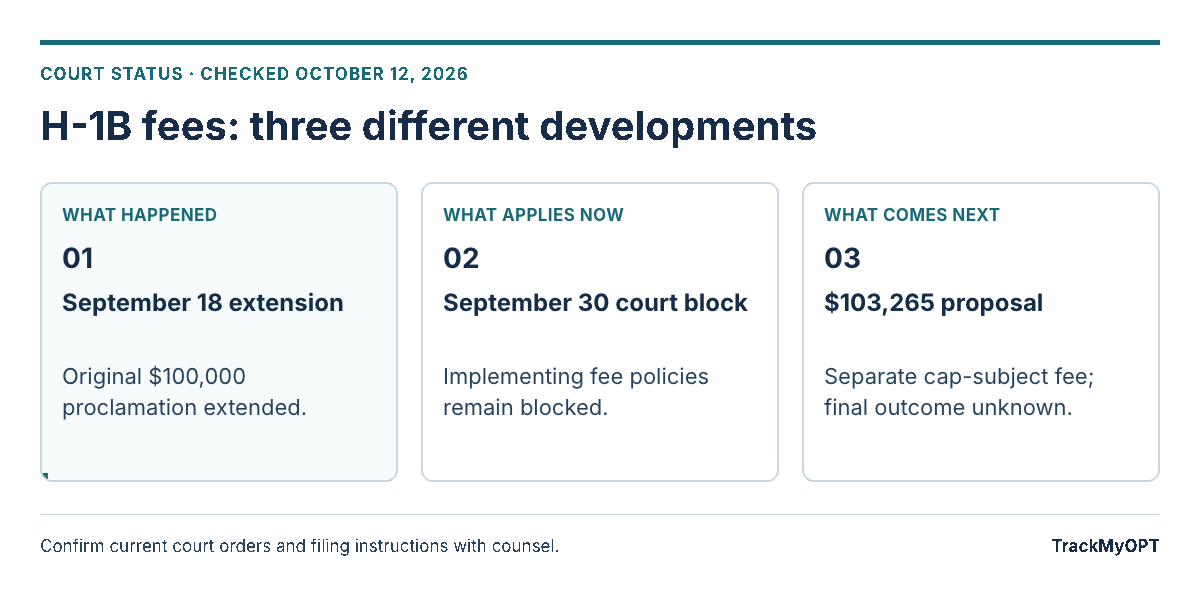
- 1. September 18: original $100,000 proclamation is extended.
- 2. September 30: court blocks implementing payment policies; monitor litigation.
- 3. Separate $103,265 cap-subject proposal requires a final rule before it becomes due.
- Proposed petition fee: $103,265; cap-subject scope; a final effective requirement has not been identified in this review.
- Proclamation payment: $100,000; separate entry-related framework; implementing policies remain subject to court orders.
- Ordinary filing costs: confirm the applicable current fee schedule for the actual petition, rather than adding headline amounts.
What the September 30 Court Development Adds
Justice Action Center, which represents plaintiffs in Global Nurse Force v. Trump, reports that the September 30 preliminary injunction blocks agency action implementing the $100,000 requirement under both the original proclamation and its 2026 extension. Its update distinguishes the proclamation itself from the agency policies enforcing the payment. The University of Michigan’s October 1 notice also reports that the fee remains blocked.
This guide labels the litigation page as a report from plaintiffs’ counsel. A new order, appeal ruling or implementing measure could change the position later. Before acting, ask the employer’s attorney to check the operative orders and current agency instructions. Do not treat a blog’s publication date as a legal assurance that the court situation cannot change.
Sources: Global Nurse Force v. Trump — plaintiffs’ current litigation update; October 1 update: extended $100,000 payment remains blocked
Who Would the $103,265 Proposal Cover?
DHS describes the proposal as applying to petitions subject to the annual H-1B cap, including the U.S. advanced-degree exemption. The regular cap is 65,000 and the advanced-degree exemption is 20,000. The proposal excludes petitions that are not cap-subject; the classification of a particular filing still needs review.
For a graduate, the important question is the actual petition category. “Nonprofit,” “university partner” or “research role” in a job advertisement does not by itself resolve cap exemption. Ask the employer and counsel what category they expect to file under and why. If the answer changes, record the revised plan and revisit the timing instead of assuming the first description controls.
Sources: Fee for Certain H-1B Petitions (proposed rule, 91 FR 54817)
Example: Nisha Is Planning an In-Country Transition
Nisha is fictional. She is working on STEM OPT and discussing a future H-1B petition. After seeing two six-figure headlines, she worries that she personally owes both amounts immediately. She separates her current EAD and reporting duties from the employer’s future filing plan. She sends HR the dated sources and asks the immigration team to identify the relevant petition category.
Nisha’s useful questions are concrete: which measure could apply, whether it is effective for the planned filing, who is responsible for the costs, and what would trigger a reassessment. She does not promise to repay immigration costs or sign a new deduction agreement before getting advice. The example demonstrates how to organize a conversation; it does not determine the treatment of any real in-country case.
Vinay's practical note
Ask which legal measure applies to which filing. Adding two news headline amounts is not a filing-fee calculation.
Example: Omar Is Considering Travel and Consular Processing
Omar is fictional. His employer discusses a filing that may involve consular processing. He has heard that a friend’s change-of-status case had different fee treatment, so he asks counsel to compare the routes using his own documents. He also asks whether travel would alter the plan, rather than assuming the friend’s answer transfers to his case.
He keeps the proposed filing route, approval details and travel dates in one private record. When a court update appears, he asks whether it changes any instruction the employer previously gave him. He does not buy a ticket based on a social media summary. A useful policy explainer can identify the questions, while the attorney must evaluate the actual petition and travel sequence.
Does This Change OPT or STEM OPT Today?
These H-1B measures concern a future employer petition or an entry-related framework. They should not be used as a substitute for checking current OPT eligibility, employment reporting and EAD dates. A student’s present authorization and an employer’s potential future budget are distinct planning items.
There is also a separate October proposal concerning OPT fees. If you are following several headlines at once, keep a list with the document name, docket, proposed or effective status, covered application and next milestone. That makes it easier to notice when a news article is discussing a different measure. It also prevents a change in one process from accidentally overwriting reminders for another.
A Practical Employer Conversation
Ask HR who owns immigration review and when the employer expects to make a sponsorship decision. Share sources as questions, not declarations that the company must pay a particular amount. If budgeting is still under review, request a date for the next update and ask how any delay interacts with your current work authorization.
Keep the response in writing. Distinguish a company’s policy decision from a government filing requirement: an employer might change its plans even while a fee remains proposed, but that does not turn the proposal into law. If the company asks you to pay or reimburse costs, qualified counsel should review the specific arrangement before you agree.
What to Watch Next
For the $103,265 proposal, watch for a final rule, scope changes and an effective date. For the $100,000 framework, watch for operative court orders and agency implementation notices. The September 10 technical correction to the proposal’s receipts table did not itself finalize the proposed fee.
Use this H-1B fees October 2026 comparison to separate the measures, then confirm the current rule for the actual filing. Track your EAD and immigration milestones while the employer evaluates sponsorship. The safest useful conclusion is a documented plan with dates and responsible people, not a predicted fee total.
Your Action Checklist
Common Mistakes to Avoid
- Treating a proclamation extension as proof that blocked policies are enforceable.
- Describing the $103,265 proposal as a current charge.
- Adding unrelated fee headlines into a personal bill.
- Assuming every nonprofit position is cap-exempt.
Research employers with real filing history
Compare H-1B filing history, entry-level signals, common roles, and verified career links before spending hours on an application.
Also see H-1B sponsor research features
Frequently Asked Questions
Is the $103,265 H-1B fee in effect in October 2026?
In the sources reviewed October 12, it remains a proposed fee. The August 25 notice and September 10 table correction are not a final effective rule. The September 24 comment deadline has passed. Confirm whether a later final rule exists before a filing.
Is the $100,000 payment the same measure?
No. It comes from a separate presidential entry-restriction framework. The September 18 proclamation extended it, while the current litigation update reports a court block on implementing payment policies. The proposed $103,265 fee has a different rulemaking basis and cap-subject scope.
Does an OPT student personally owe these headline amounts?
A headline does not establish a personal bill. H-1B petitions are employer-filed, and applicability depends on the measure, filing category, current legal status and facts. Ask the employer and counsel about the actual costs and any proposed reimbursement arrangement before agreeing to pay.
Should I stop working on OPT because of the fee proposal?
The proposal does not itself replace your current work-authorization rules. Check your EAD dates, qualifying employment and reporting obligations. Discuss future sponsorship with the employer, but do not change current employment or travel plans solely because a proposed fee appeared in the news.
Official Sources
Rules can change. We checked this guide against the primary sources below; always open the current form instructions or agency page before acting.
- Fee for Certain H-1B Petitions (proposed rule, 91 FR 54817) — U.S. Department of Homeland Security / USCIS
- August 25 proposed rule — official PDF — GPO / Federal Register
- September 18 proclamation extending the H-1B entry restrictions — White House
- Global Nurse Force v. Trump — plaintiffs’ current litigation update — Justice Action Center (plaintiffs’ counsel)
- October 1 update: extended $100,000 payment remains blocked — University of Michigan International Center
Keep Reading
Written by Vinay Kumar
Vinay is a content writer at TrackMyOPT who specializes in immigration guidance for international students. All content is researched using official USCIS, SEVP, and Department of Labor sources and reviewed for accuracy by the TrackMyOPT team, which includes former F-1 students who navigated OPT, STEM OPT, and H-1B transitions firsthand.