EAD Card Lost, Stolen, Incorrect or Never Delivered? Complete Recovery Guide
Not all EAD problems are solved the same way. A card that never arrived, a card with the wrong dates, and a card that was stolen each require a different response. Use this guide to identify which situation you are in and exactly what to do next.
Direct Answer
Diagnose the problem first—is the card lost/stolen/damaged, was it printed with incorrect data, or was it never delivered? Each category has a different USCIS remedy. Do not apply the wrong remedy (e.g., filing a lost-card replacement when the issue is a USCIS printing error). Save the approval notice, USPS tracking number, and any returned-mail evidence before contacting USCIS. Do not work without confirmed work authorization, regardless of the cause of the delay.
Step 1: Diagnose Your EAD Problem
Before you take any action, identify which of the four EAD problem categories applies to your situation. The remedy differs significantly between categories.
Category A
Lost, Stolen, or Damaged Card
You received a valid card, but it was later lost, stolen, damaged, or destroyed.
File a new Form I-765 as a replacement with applicable fee.
Category B
USCIS Printing Error
The card arrived but contains incorrect data due to a USCIS or printing error (wrong name, dates, or A-number).
Follow USCIS's correction process for agency errors — may not require a new fee.
Category C
Applicant Data Error
The card data is wrong because of an error in your original Form I-765 application.
File a new Form I-765 to correct the error — fee may apply.
Category D
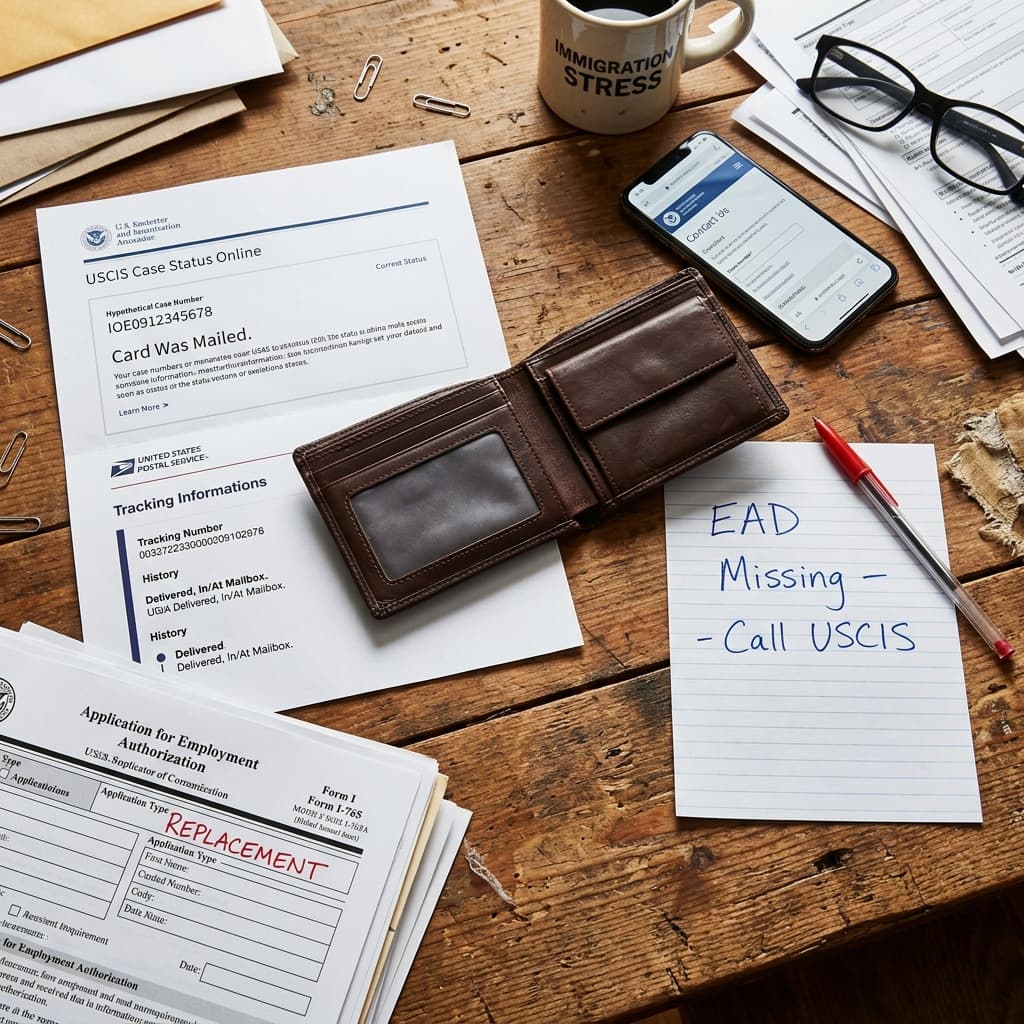
Card Never Delivered
USCIS shows the card as mailed but it never arrived. USPS tracking may show delivered but you never received it.
Use the USCIS Non-Delivery of Card inquiry tool at the appropriate time.
Do not work without confirmed authorization
Regardless of which EAD problem you are dealing with, do not assume that your underlying OPT approval allows you to work without the physical card. Confirm with your employer's HR and your DSO what documentation is acceptable for I-9 purposes during the replacement process. An approval notice or receipt notice is generally NOT sufficient on its own for I-9 completion.
Category A: Lost, Stolen, or Damaged EAD
Immediate steps
- Write down when and where you last had the card and when you first noticed it was missing. This information may be requested by USCIS or law enforcement.
- File a police report if the card was stolen. This is not required by USCIS for a replacement but can be useful evidence and protects you if the card is misused.
- Photograph both sides of any remaining documentation — your approval notice, receipt notice, passport, and any old copies of the EAD you may have taken.
- Contact your DSO and inform them of the situation. Your DSO may need to provide a letter or updated I-20 depending on your school's process for replacement applications.
Filing the replacement Form I-765
Download the current Form I-765 and instructions from uscis.gov/i-765. For a replacement due to loss, theft, or damage, you will need to:
- Select the correct eligibility category on the form (the same category as the original application)
- Pay the current filing fee (check the USCIS fee schedule — it changes periodically)
- Include a signed explanation of the loss or theft
- Include the police report if one exists
- Include copies of your original approval notice and other supporting documents
Processing times for replacement EADs can be several months. You may request premium processing if USCIS offers it for your category at the time of filing—check the current I-765 filing address and premium processing information before submitting.
Category B: USCIS Printing or Data Entry Error
If you compare the card to your approval notice and find that USCIS printed the wrong data (wrong name spelling, wrong dates, wrong A-number, wrong category code), the correction process is different from a replacement.
How to identify a USCIS error vs. your own error
| USCIS or Printing Error | Applicant Error |
|---|---|
| Card says different name than approval notice | Card matches the name submitted on Form I-765 (which had a typo) |
| Card dates differ from approval notice dates | Card matches the dates but the Form I-765 had wrong dates |
| A-number on card differs from notice | A-number was entered incorrectly on the application form |
| Wrong category code printed on card | Wrong eligibility category was selected on the form |
Correcting a USCIS printing error
Follow the USCIS correction instructions for agency errors, which typically require:
- A cover letter explaining the discrepancy with evidence
- Copies of both the incorrect card and the approval notice
- Identity documents that show the correct information
- Submission to the address listed in current USCIS guidance
Do not alter the card in any way. Photograph it as-is, then send the original card with the correction package if USCIS requires it. Check the current I-765 instructions for the latest correction procedure, as USCIS may update these periodically.
Category C: Applicant Error on Form I-765
If the error on the card stems from incorrect information you submitted on Form I-765, a correction for agency error does not apply. You will generally need to file a new Form I-765 with the correct information and pay the applicable fee. Include a cover letter explaining the original error and providing the corrected information.
Ask your DSO whether a new I-20 or updated I-765 supporting documents are needed for the corrected application.
Category D: EAD Card Never Delivered
This is one of the most stressful situations because USCIS shows the card as mailed and the responsibility seems unclear. Follow these steps in order:
Step 1: Check USCIS case status
Log in to your USCIS online account or use the case status tool at egov.uscis.gov and confirm the case status shows the card was mailed (or produced). Note the exact status text and the date.
Step 2: Check USPS tracking
USCIS typically mails EADs via USPS First Class Mail with tracking. If you have the tracking number (it may appear in your online account or in a notification email), check the USPS tracking status at USPS Tracking.
- Status: Delivered — Check with neighbors, building management, or your mail carrier. File a USPS Mail Theft report if you believe the card was stolen from your mailbox.
- Status: In transit / no update for many days — The card may be lost in transit. Proceed to the non-delivery inquiry.
- Status: Return to sender — The card may have been sent to an old address. Contact your DSO to verify and update your address in SEVIS, then inquire about reissuance.
Step 3: File a USCIS Non-Delivery of Card inquiry
USCIS provides a specific tool for EAD non-delivery situations at egov.uscis.gov/e-request/ndc. The tool will ask for your receipt number and explain the conditions for submitting an inquiry (typically, a specific number of days must have passed since the card was mailed). Submit the inquiry when you qualify, and record the inquiry confirmation number.
Track your case in the TrackMyOPT USCIS case status dashboard so you are notified immediately when the status changes.
Address issues
USCIS mails to the address on your Form I-765. If you moved after filing, the card goes to the old address. Contact your DSO immediately about updating your address in SEVIS. Check the USPS mail forwarding status if you filed a forwarding request.
While You Wait for a Replacement
The EAD replacement process can take weeks to months. During this time:
Do not assume you can work
Confirm with your employer HR and DSO what documentation is acceptable for I-9 during the replacement.
Keep your USCIS approval notice accessible
This is your proof of the underlying approval even without the physical card.
Track unemployment days
If you cannot work because of the EAD problem, days may count toward your 90-day limit. Contact your DSO.
Save all correspondence
Every inquiry number, USPS tracking update, USCIS response, and DSO email should be preserved.
Consider premium processing if available
Check whether premium processing is available for your replacement filing to reduce processing time.
Frequently Asked Questions
Can I work if my OPT EAD was lost?
Do not assume that losing the physical card eliminates your work authorization. However, your employer needs to complete Form I-9 and typically needs to see the EAD card. Discuss your specific situation with your employer's HR team, DSO, and ideally an immigration attorney before performing any work without the physical card.
What if USCIS printed my name incorrectly?
Follow USCIS's correction process for agency errors, not the standard replacement process. Include the incorrect card, your approval notice, and identity documents showing the correct name. Do not alter the card. Check the current I-765 instructions for the correction submission address.
When can I submit an EAD non-delivery inquiry?
The USCIS Non-Delivery of Card tool at egov.uscis.gov/e-request/ndc specifies the timing requirements — typically a set number of days after the card was mailed. Check the tool directly for current requirements before submitting, as timing rules can change.
Does an approval notice replace the EAD for work purposes?
Generally no — the I-9 process requires presenting specific documents from a specific list. An approval notice or receipt notice is not automatically an acceptable I-9 work authorization document. Confirm with your employer's HR team and an immigration attorney.
My EAD shows as delivered by USPS but I never received it. What do I do?
Check with neighbors and building management first. File a USPS mail theft report if you believe it was stolen. Then file the USCIS Non-Delivery of Card inquiry. In the meantime, contact your DSO about the situation and whether any action is needed in your SEVIS record.
Does the time waiting for a replacement EAD count as OPT unemployment?
If your OPT authorization period has started and you cannot work because you lack the physical EAD, those days may count toward your unemployment limit depending on the facts. Contact your DSO to understand how the situation is being recorded and whether it affects your unemployment count.
Official Sources
Immigration Disclaimer: This article is for general informational purposes only and does not constitute legal advice. EAD replacement rules and USCIS processes change frequently. Always consult your DSO and a licensed immigration attorney before making decisions about working without a valid EAD card.
Related Guides
Can You Work Before Your EAD Arrives?
The authorization timing, I-9 requirements, and employer communication guide.
Read GuideComplete OPT EAD Card Guide
Everything about the EAD card: categories, reading the card, and common questions.
Read GuideHow to Track Your USCIS Case Status
Case status tools, inquiry timelines, and next steps for pending cases.
Read GuideOPT Employment Evidence Checklist
Every document to keep — including your EAD approval notice and card copies.
Read GuideWritten by Vinay Kumar
Vinay is a content writer at TrackMyOPT who specializes in immigration guidance for international students. All content is researched using official USCIS, SEVP, and Department of Labor sources and reviewed for accuracy by the TrackMyOPT team, which includes former F-1 students who navigated OPT, STEM OPT, and H-1B transitions firsthand.