OPT Employment Evidence Checklist: What to Save for USCIS and Future Visas
The documents you collect today are the proof you will need tomorrow—for your DSO, for an RFE, for an H-1B petition, and for every future visa application that asks about your work history. This checklist ensures you never face a gap.
Direct Answer
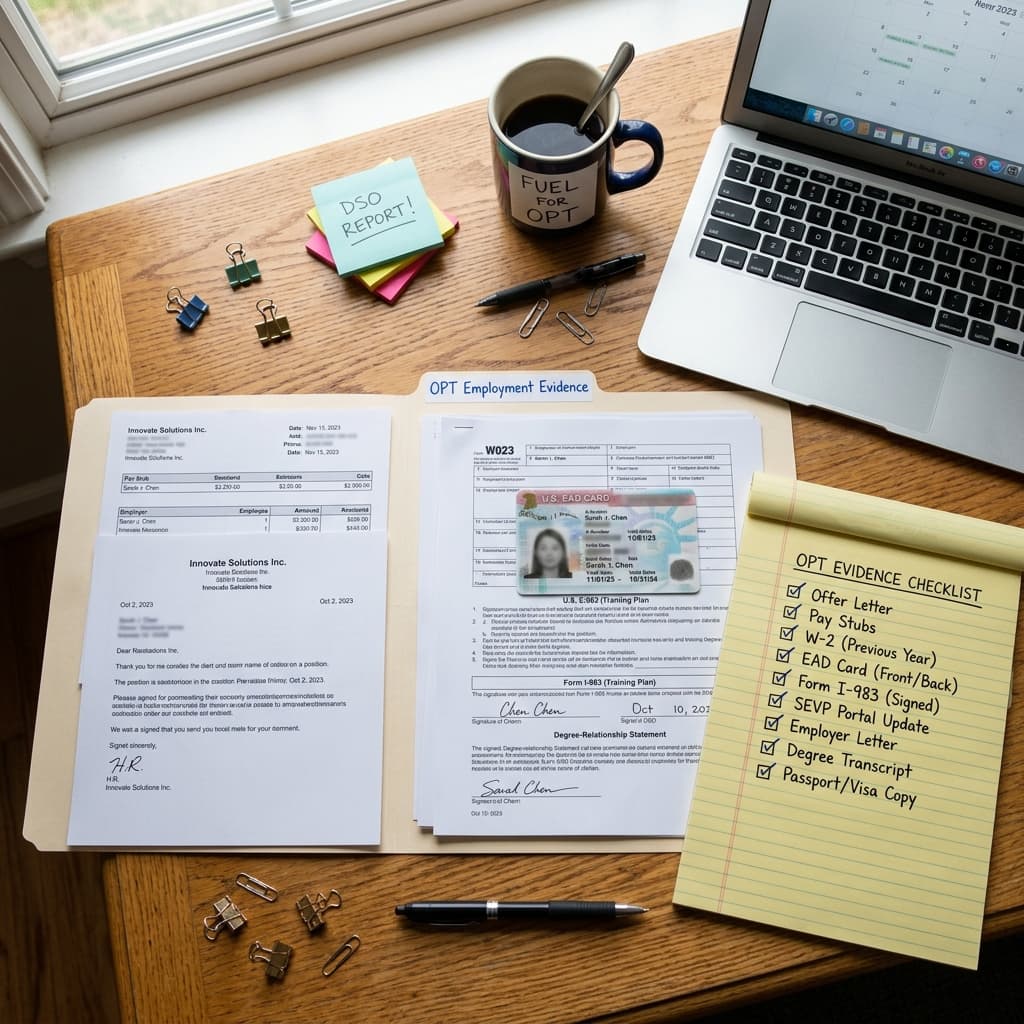
For each OPT employer, collect and keep: signed offer letter, job description, start and end dates, worksite address, supervisor contact, hours per week, pay records, and a short explanation of how the role relates to your degree. Add DSO/SEVP confirmation of the employment report and, for STEM OPT, your Form I-983 and all evaluations. Keep records in separate employer folders and preserve them after OPT ends — immigration filings can require this history years later.
Why OPT Employment Evidence Matters Beyond OPT
Most students think about OPT documentation as a compliance tool for their DSO. That is true—but it is only the short-term view. OPT employment evidence is also:
- H-1B petition support: USCIS may request evidence that your prior OPT employment was in a specialty occupation consistent with the H-1B role being petitioned.
- Green card PERM foundation: PERM audits can require documentation that the employer has consistently employed you in the specialty occupation during and after OPT.
- O-1A extraordinary ability evidence: OPT employment records can support an original contribution or high-salary criterion.
- Future visa application history: Consular officers often ask applicants to account for all employment since graduation. Missing records create credibility issues.
- RFE responses: USCIS can issue an RFE for an H-1B petition asking for proof that prior OPT employment was related to the specialty occupation. A complete OPT evidence file turns a stressful RFE into a manageable response.
The 7-Year Rule for Immigration Records
Keep OPT employment records for at least 7 years after the OPT period ends — or longer if you are in an ongoing immigration process (green card, naturalization). Do not delete files because you think OPT is behind you. A green card application or naturalization interview can ask about employment going back to your first authorized period in the United States.
The Folder System: One Folder Per Employer
The simplest organizational approach is to create one digital folder per employer, named with the employer name and employment dates. Within each folder, use sub-folders for the categories below.
Category 1: Offer and Job Documentation
Signed offer letter
Confirms the offer date, start date, position, salary, and employer.
Final job description
The version you were actually hired under — not just what was posted online. Print the posting if possible.
Any employment agreement or contractor agreement
Especially important for staffing or consulting arrangements.
Non-disclosure agreement (NDA)
Confirms the employment relationship and employment start date.
Benefits enrollment confirmation
Evidence of the employment relationship and start date.
Category 2: Employment Dates and Work Location
Written start date confirmation
Email from HR, offer letter, or I-9 completion date.
Written end date confirmation
Termination notice, resignation acceptance, separation agreement.
Worksite address
Must match what is reported to your DSO. Critical for STEM OPT and remote work situations.
Schedule or work-hours documentation
Evidence that you met the 20-hour minimum for qualifying employment.
Remote work authorization or agreement
Documents that your remote arrangement was authorized and supervised.
Category 3: Proof of Compensation
Pay stubs for each pay period
Best proof of actual compensation, dates of employment, and employer identity.
W-2 for each calendar year
Essential for future tax consistency and visa applications.
Direct deposit records
Secondary confirmation of employment dates and pay.
1099 forms (if applicable for initial OPT freelance)
Confirms the employment relationship and amount. Keep all 1099s even for small amounts.
Category 4: Degree Relationship Documentation
Degree-relationship statement
Your written explanation of how the role's duties connect to your major. See the degree-relationship guide for how to write this.
Supervisor or hiring manager letter (if needed)
Signed statement confirming the role's technical requirements and how they align with your degree.
Performance reviews or project summaries
Secondary evidence that your actual duties were consistent with what you reported.
Technical documentation or project descriptions
If you can document the projects you worked on without violating NDA, keep a plain-language description.
Category 5: Reporting and Compliance Records
DSO confirmation of employment reporting
Email or portal confirmation that the employer, start date, and worksite were reported.
SEVP Portal screenshot at time of reporting
Captures what was in the record when reporting occurred.
I-20 recommending the OPT period
Confirms the authorized period and academic connection.
EAD card copy (front and back)
Confirms your authorization category, dates, and USCIS approval.
USCIS approval notice (I-797 or EAD approval)
Official proof of OPT approval with receipt and approval dates.
Category 6: STEM OPT Additions
If you are on STEM OPT, add these documents to the employer folder:
Completed and signed Form I-983 (all pages)
The training plan agreement with the employer. Keep every version if the plan is amended.
Employer E-Verify company ID confirmation
Proof that the employer was actively enrolled when you began.
12-month self-evaluation (signed)
Required evaluation at month 12 of STEM OPT — keep the student and employer portions.
Final evaluation (signed)
Required when the STEM training opportunity ends.
Six-month validation confirmations
DSO confirmation that each six-month validation was completed on schedule.
Category 7: Personal Immigration Records (Lifetime File)
Separate from employer folders, keep a lifetime immigration record that covers your entire history in the United States:
- Every I-20 issued throughout your academic career
- Every visa stamp (photograph both the visa page and the entry stamp)
- Every EAD card received
- All passports (including expired — the entry stamps matter)
- Travel records (dates of every entry and exit, airline tickets, passport stamps)
- Tax returns for each year you were in the United States
- All USCIS correspondence (receipts, approvals, denials, RFEs, responses)
TrackMyOPT Document Vault
Store your employer folders, I-20s, EADs, and evaluation records in one organized, secure location. The Document Vault is structured around the OPT compliance categories above so your files are always where you need them.
Open Document VaultCommon Gaps and How to Fix Them
| Gap | How to Address It |
|---|---|
| No offer letter from employer | Request a retroactive confirmation letter with position, start date, salary, and supervisor. An email from HR is acceptable. |
| No pay stubs | Request duplicate statements from your payroll provider. Most employers use ADP, Paychex, or Gusto — contact HR for the payroll access link. |
| No degree-relationship statement | Write one now based on your actual duties. Ask your former supervisor to confirm by email if you can still reach them. |
| DSO reporting confirmation was not saved | Ask your DSO for a copy of the reporting confirmation or SEVIS record entry. DSOs typically have records of employment updates. |
| Lost EAD card | Request a replacement through USCIS. Keep the approval notice, receipt notice, and any non-delivery inquiry records. |
Frequently Asked Questions
How long should I keep OPT employment records?
Keep them for at least 7 years after the OPT period ends, and longer if you are in an ongoing immigration process such as a green card or naturalization application. Immigration filings can require employment history going back to your first authorized work period in the United States.
Do I need pay stubs if I worked an unpaid position on initial OPT?
Keep whatever evidence applies to the role — offer letter, volunteer agreement, supervisor contact, hours confirmation, project records, and a statement from the organization confirming your participation. Ask your DSO what additional documentation is appropriate for the specific unpaid position.
What if my former employer went out of business?
Preserve everything you already have — pay stubs, W-2s, offer letters, email correspondence, and LinkedIn records from the time. If you need additional documentation, a CPA or immigration attorney can sometimes help reconstruct an employment record from tax returns and payroll records.
My employer refuses to give me a job description. What should I do?
Keep your written request and the employer's refusal (or non-response). Preserve the offer letter, performance reviews, project documentation, supervisor contact, and any other written evidence of duties. Write your own accurate duties summary. Consult your DSO or attorney about whether the available documentation is sufficient.
Can I use TrackMyOPT to store sensitive immigration documents?
TrackMyOPT's Document Vault is designed for OPT compliance records. Review the product's current privacy policy, data security terms, and backup policies before uploading any sensitive immigration documents.
Does the evidence I keep for OPT affect my H-1B petition?
Yes — significantly. If USCIS issues an RFE on your H-1B petition asking for evidence that you were engaged in a specialty occupation during OPT, a complete OPT employment evidence file lets your attorney respond with offer letters, job descriptions, pay stubs, degree-relationship statements, and supervisor confirmations. Without this, the response is much harder to build.
Official Sources
Immigration Disclaimer: This article is for general informational purposes only and does not constitute legal advice. Consult your DSO and a licensed immigration attorney for advice specific to your OPT situation and future visa planning.
Related Guides
How to Prove Your OPT Job Relates to Your Degree
Duty-based relationship statements with examples across 5 fields of study.
Read GuideLost or Incorrect EAD Card Guide
What to do when your EAD is lost, stolen, printed incorrectly, or never delivered.
Read GuideLaid Off on OPT
Reporting steps, unemployment tracking, and job search after a layoff.
Read GuideOPT to H-1B Transition Guide
How your OPT employment record affects your H-1B petition.
Read GuideWritten by Vinay Kumar
Vinay is a content writer at TrackMyOPT who specializes in immigration guidance for international students. All content is researched using official USCIS, SEVP, and Department of Labor sources and reviewed for accuracy by the TrackMyOPT team, which includes former F-1 students who navigated OPT, STEM OPT, and H-1B transitions firsthand.