F-1 Visa Social Media Screening in 2026: What Officers Can Review
The State Department conducts online-presence review for student visa applicants and instructs F, M, and J applicants to make social profiles public or open. This guide separates the confirmed requirements from rumors and provides a practical accuracy audit.
Direct Answer
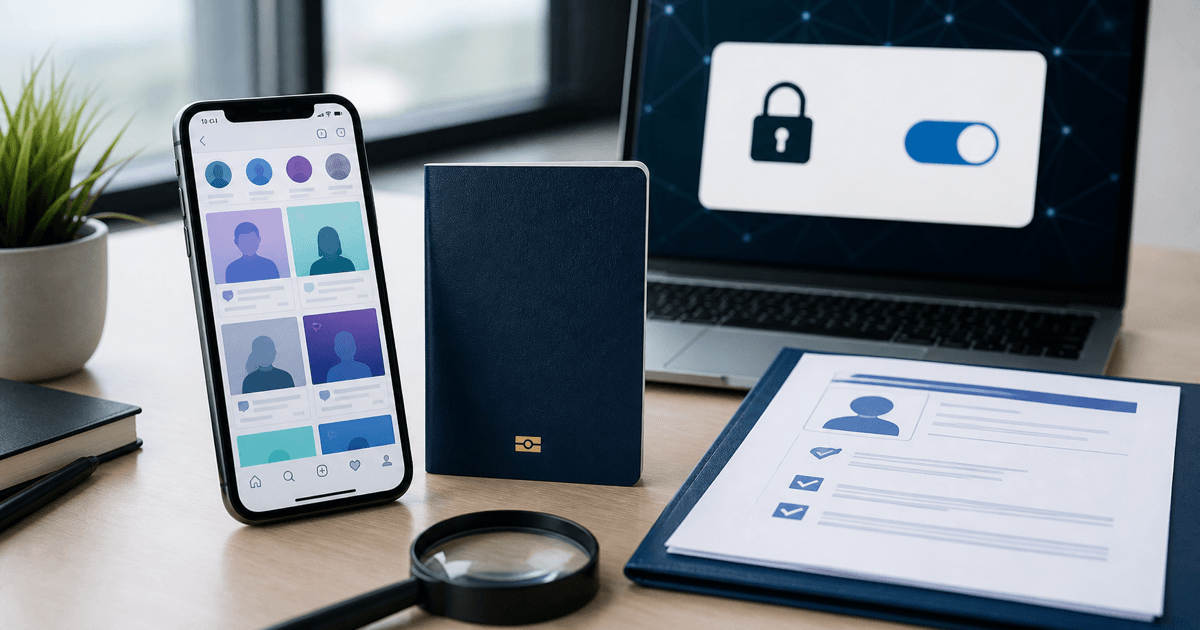
F-1 visa applicants are subject to online-presence review. The State Department instructs F, M, and J applicants to set all social media profiles to public or open, while the DS-160 requests social-media identifiers used during the preceding five years. Official guidance says officers do not request passwords. The agency does not publish an exhaustive list of every post, keyword, or platform factor it evaluates.
What Is Officially Confirmed About F-1 Social Media Screening?
TheState Department’s student and worker screening announcementstates that all F, M, and J nonimmigrant visa applicants are subject to online-presence review. It instructs those applicants to make all social media profiles public.
A March 25, 2026expanded-vetting announcementrepeats that F, M, and J applicants are already covered and uses the wording “public” or “open.” The same notice expands review to additional visa categories, but it does not remove student applicants from the process.
Online review
Confirmed for F, M, and J visa applicants.
Public profiles
Applicants are instructed to change profiles to public or open.
No passwords
The official FAQ says officers do not request account passwords.
What Social Media Information Does the DS-160 Request?
Since May 31, 2019, most immigrant and nonimmigrant visa applications have requested social media identifiers. A social-media identifier is a username, handle, or other name used on a listed platform—not the password.
The officialsocial-media identifier FAQexplains that applicants must provide requested identifiers used during the preceding five years. It also says applicants who never used a listed platform may answer “None” when the form provides that option. A false “None” response is not a privacy strategy.
Prepare this information before starting the DS-160
- Current usernames and profile URLs for platforms listed on the form.
- Old usernames used within the requested five-year period.
- Accounts that changed names after a move, graduation, or job change.
- A copy of the final DS-160 answers retained with the visa application record.
Thecurrent DS-160 FAQemphasizes that answers must be accurate and complete. Errors can require correction and rescheduling of the interview.
What Can an Online-Presence Review Compare?
The Department of State says it uses available information to determine identity and visa eligibility under U.S. law. It does not publish a comprehensive scoring rubric. For an F-1 or OPT applicant, the practical concern is whether public information conflicts with the application and immigration record.
| Public information | Record it may be compared with | Common consistency question |
|---|---|---|
| School and degree | DS-160, I-20, SEVIS history | Do institution, program, and dates match? |
| Employer and job title | OPT reporting, résumé, employment letter | Are employer, dates, location, and duties consistent? |
| Freelance or business activity | Work authorization and visa category | Was the activity authorized and related to the degree? |
| Travel and residence | DS-160 address and travel history | Do locations and dates tell the same story? |
| Identity details | Passport and prior applications | Are names, handles, and biographical facts attributable to the applicant? |
For OPT students, compare the public employment story against theOPT employment evidence checklistand the information reported through the DSO or SEVP Portal. An ordinary title difference may have an innocent explanation; fabricated employment or unauthorized work is a materially different issue.
What the Government Has Not Publicly Confirmed
Online discussions frequently turn a limited announcement into an invented checklist. The official sources reviewed for this article do not publish:
- A list of prohibited lawful opinions, ordinary jokes, or lifestyle photos.
- A promise that deleting a post or account prevents the government from finding it.
- A requirement to volunteer passwords or send private messages to an officer.
- A fixed number of posts, years, or platforms an officer will manually inspect beyond the form’s requested identifiers.
- A guarantee that a perfectly consistent public profile will result in visa issuance.
Do not manufacture a cleaner history
Concealing requested identifiers, deleting evidence of unauthorized work, or changing dates to match an application can create a credibility or misrepresentation issue. Correct genuine errors transparently and obtain qualified legal advice for material problems.
Seven-Step F-1 Social Media Accuracy Audit
Inventory every requested identifier
List current and prior handles used during the DS-160 lookback period. Do not rely on memory during submission.
Follow the public-profile instruction
Before the interview, review the current State Department and embassy instructions and set covered profiles to public or open as directed.
Reconcile identity and education
Compare names, schools, degrees, dates, locations, and program details with the passport, DS-160, I-20, and SEVIS record.
Reconcile OPT employment
Match employer names, job dates, locations, and role descriptions with DSO or SEVP reporting and employment evidence.
Identify unauthorized-work concerns
Separate innocent wording differences from freelance, gig, startup, or side work that may have required authorization.
Preserve the submitted record
Save the DS-160 confirmation and a private list of answers, identifiers, corrections, and supporting records.
Escalate material inconsistencies
Ask a licensed U.S. immigration attorney about omissions, false information, arrests, status violations, or work-authorization concerns before the interview.
Also review the broaderOPT and CPT compliance environment, but rely on the primary sources above for the actual social-media rule. The public profile is one part of a visa case, not a substitute for statutory eligibility.
Frequently Asked Questions
Do F-1 visa applicants have to make social media profiles public?
The State Department instructs F, M, and J nonimmigrant visa applicants to adjust the privacy settings on all social media profiles to “public” or “open” to facilitate online-presence review. Follow the current instructions from the embassy handling the application.
Does the U.S. government ask for social media passwords?
The State Department’s official social-media identifier FAQ says consular officers will not request user passwords and will not attempt to subvert privacy controls. Applicants should never provide a password merely because an unofficial person or website claims it is required.
How many years of social media history does the DS-160 request?
The DS-160 social-media questions generally request identifiers used on listed platforms during the preceding five years. Applicants should answer the current form exactly as presented and disclose requested identifiers accurately, including old handles they actually used.
Should I delete old posts before an F-1 visa interview?
Do not delete or alter information to conceal facts or create a misleading record. There is no official promise that deleting content prevents review, and an inaccurate DS-160 or inconsistent explanation can create a separate credibility problem. Preserve records and obtain legal advice for serious concerns.
Does social-media screening apply to every F-1 student in the United States?
The public-profile instruction discussed here applies to applicants seeking F, M, or J visas through the State Department. It is not a blanket announcement ordering every person currently maintaining F-1 status inside the United States to keep all profiles public indefinitely.
The Bottom Line
F-1 visa social media screening in 2026 is real: student visa applicants face online-presence review, are instructed to make profiles public or open, and must disclose requested identifiers accurately. What is not supported is the idea that officers demand passwords or follow a published list of disfavored ordinary posts. Prepare by making the public facts consistent with the immigration record—not by trying to erase or rewrite history.
Keep the Immigration Record Consistent
TrackMyOPT helps students track employment dates, unemployment days, reporting obligations, and documents—the facts that should match a visa application and public professional history.
Create Your Free AccountOfficial Sources
- Department of State: Screening for H-1B, H-4, F, M, and J Applicants
- Department of State: Expanded Screening and Vetting, March 2026
- Department of State: Social Media Identifier FAQ
- Department of State: DS-160 Frequently Asked Questions
This article provides general educational information, not legal advice. Visa eligibility and the significance of any online information depend on the individual facts and applicable law.
Related Guides
- STEM OPT Extension Guide24-month STEM OPT eligibility, I-983, and filing timeline.Read more
- 90-Day Unemployment RuleWhat counts as unemployment on OPT and STEM OPT.Read more
- USCIS Case Status TrackingHow to track your I-765 and understand status updates.Read more
- OPT to H-1B TransitionCap-gap, lottery timing, and what to do if not selected.Read more
Written by Vinay Kumar
Vinay is a content writer at TrackMyOPT who specializes in immigration guidance for international students. All content is researched using official USCIS, SEVP, and Department of Labor sources and reviewed for accuracy by the TrackMyOPT team, which includes former F-1 students who navigated OPT, STEM OPT, and H-1B transitions firsthand.