F-1 vs J-1 Visa: Which is Better for International Students?
Compare the F-1 and J-1 student visas. Learn the differences between OPT and Academic Training, spouse work rules, and the dreaded 2-year home residency requirement.
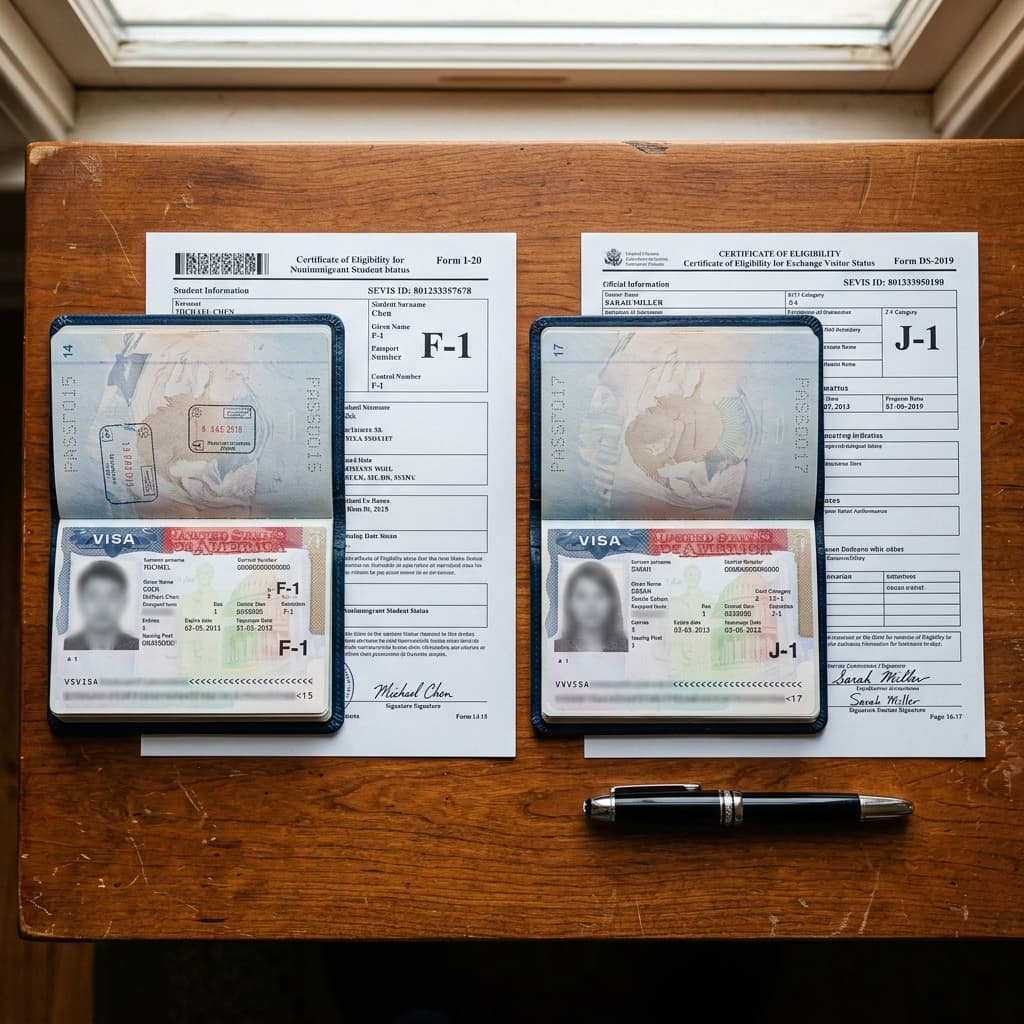
When you are accepted into a US university, you will usually be issued an I-20 document to apply for an F-1 Student Visa. However, if your studies are funded by a scholarship, a government grant, or an exchange program, you might be issued a DS-2019 document to apply for a J-1 Exchange Visitor Visa.
While both allow you to study full-time in the US, the rules regarding post-graduation work and dependents are vastly different. Choosing the wrong visa can permanently derail your US career plans.
Post-Graduation Work: OPT vs. AT
The biggest difference between the F-1 and J-1 visas is how you are allowed to work in the US after you graduate.
F-1 Visa: OPT
- Length: 12 months standard + 24-month STEM extension (up to 3 years total).
- Process: Requires applying to USCIS for an EAD card (takes 2-4 months and costs $410).
- Flexibility: You can work for any employer, as long as the job is related to your major.
J-1 Visa: Academic Training (AT)
- Length: Up to 18 months for most students (or up to 36 months for Post-Doctoral researchers). No STEM extension.
- Process: Approved instantly by your J-1 sponsor (Responsible Officer). No USCIS application or fee required!
- Flexibility: You must have a specific job offer before your sponsor will authorize AT.
Winner: F-1 Visa. While J-1 AT is faster and cheaper to get, the F-1 visa's 3-year STEM OPT extension makes it vastly superior for long-term career growth and H-1B sponsorship.
Dependents: F-2 vs. J-2 Spouses
If you are married and want to bring your spouse to the US while you study, the visa you choose has a massive impact on their quality of life.
- F-2 Dependents (F-1 Spouses): F-2 spouses are strictly forbidden from working in the United States. They cannot even freelance or work remotely for a foreign company. They are also heavily restricted in their ability to study (they can only study part-time).
- J-2 Dependents (J-1 Spouses): J-2 spouses are allowed to work in the US! After arriving, a J-2 spouse can apply to USCIS for an Employment Authorization Document (EAD). Once approved, they can work full-time in any field, for any employer. They can also study full-time.
Winner: J-1 Visa. The ability for a spouse to work and earn a US income makes the J-1 visa incredibly attractive for married graduate students and researchers.
The 212(e) Two-Year Home Residency Trap
This is the biggest drawback of the J-1 visa. If your J-1 program is funded by a government, or if your field of study appears on your home country's "Skills List," you will be subject to INA Section 212(e). This means you must return to your home country for a cumulative total of 2 years before you are allowed to apply for an H-1B visa, an L-1 visa, or a US Green Card.
If you want to build a long-term career in the US, being subject to the 212(e) requirement is devastating. While you can apply for a "J-1 Waiver," the process takes 6-12 months and is frequently denied. F-1 students are never subject to this requirement.
Document Safe: I-20s vs DS-2019s
Whether you are an F-1 student managing an I-20 or a J-1 student managing a DS-2019, you must keep every historical version of these documents for future visa applications. Use TrackMyOPT's Document Safe to scan and securely store your entire immigration history in the cloud. When USCIS asks for your documents 5 years from now, they will be right there on your phone.
Funding and Financial Aid
Most universities will only issue a J-1 DS-2019 if a substantial portion of your funding (usually 51% or more) comes from an external source, such as a Fulbright scholarship, a home country government grant, or a university fellowship. If you are paying for your own education using personal or family funds, you will almost certainly be placed on an F-1 visa.
The Verdict
Choose the F-1 Visa if: Your ultimate goal is to work in the US long-term, you want the 3-year STEM OPT extension, and you want to eventually transition to an H-1B visa and a Green Card without dealing with the 2-year home residency requirement.
Choose the J-1 Visa if: You are fully funded by a government scholarship, you absolutely need your spouse to be able to work in the US (J-2 EAD), and you intend to return to your home country after graduation.
Organize Your Visa History
F-1 and J-1 students generate a lot of paperwork. Use TrackMyOPT's Document Safe to securely store your passports, visa stamps, I-20s, DS-2019s, and EAD cards. Stop worrying about losing a piece of paper that dictates your future.