TN and TD Visa Social Media Screening: October 2026 Changes
TN and TD visa social media screening expanded October 1, 2026. Learn who is covered, what to prepare, and how Canadian admission routes differ.

Publication-status note
Checked October 12, 2026: the State Department announcement was updated September 18 and says the expanded review is effective October 1. It addresses nonimmigrant visa applicants. Do not assume it establishes identical instructions for every Canadian border-admission request.
Direct answer
TN and TD visa social media screening expanded on October 1, 2026. The State Department added TN, TD and I visa applicants to online presence review and instructed those applicants to make their social media profiles public or open. This guide is for Canadian and Mexican professionals considering TN, and accompanying family members considering TD: identify your application route before deciding which instructions apply.
What You Should Know First
- The announcement concerns visa applicants and includes TD dependents.
- A Mexican citizen’s consular visa process differs from a Canadian citizen’s usual visa-exempt TN route.
- Online presence review does not replace the underlying professional qualifications.
- An appointment or interview does not guarantee a visa issuance or travel date.
What Changed on October 1?
The September 18 State Department announcement expands online presence review to three additional classifications: I for foreign media representatives, TN for USMCA professionals, and TD for dependents. It instructs visa applicants in those classifications to set social media profiles to public or open. F-1 and several other categories were already covered by online review.
The practical first step is to locate the current instructions for the application you will submit. Save the announcement and check your consulate’s appointment guidance. A social media screenshot circulating among friends may omit both the effective date and the word “visa.” Those details matter when you compare different nationalities, routes and family members.
Sources: Expanded online presence review — September 18 announcement, effective October 1
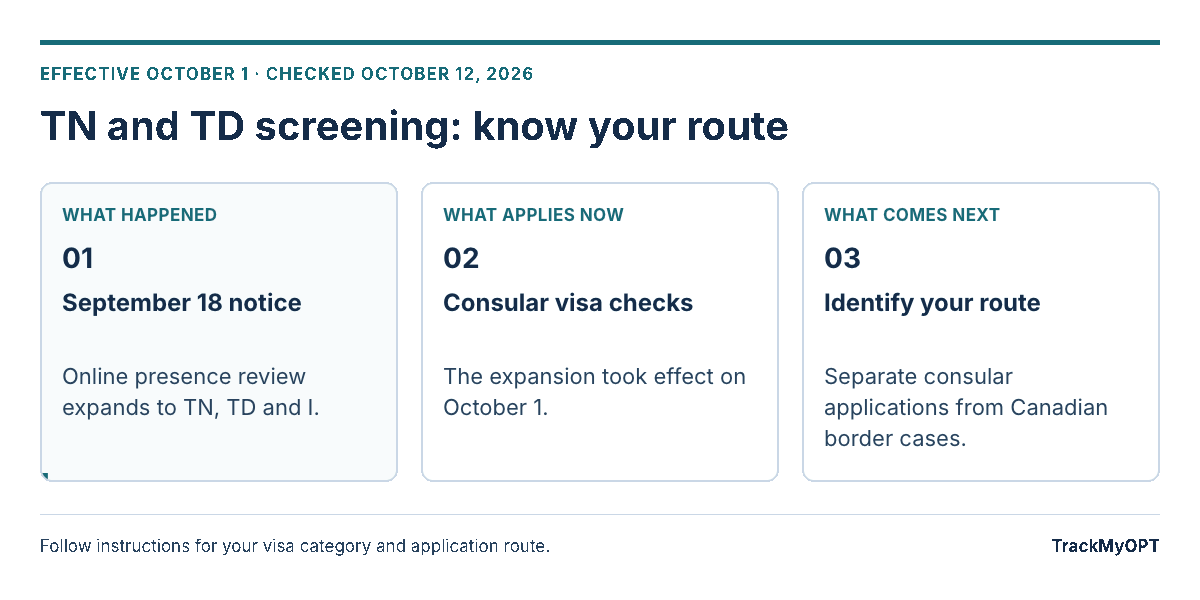
- 1. September 18: State Department announces additional categories.
- 2. October 1: online presence review expands to TN, TD and I visa applicants.
- 3. Before applying: verify consular instructions and the route each family member uses.
Visa Application and Border Admission Are Different
State Department guidance explains that Mexican citizens need a TN visa before applying for admission, while Canadian citizens generally do not need a TN visa and may request TN classification at a qualifying port of entry. A visa is a travel document; admission and status are related but separate decisions. Family members’ requirements can also depend on nationality.
That distinction prevents an overly broad reading of the October announcement. It does not itself tell every Canadian professional requesting border admission to follow a new consular social media procedure. It also does not excuse anyone from truthful answers or other screening. Verify the current route with the relevant agency and counsel rather than transferring instructions from a friend’s different process.
Sources: Visas for Canadian and Mexican USMCA Professional Workers
What to Prepare for TN Visa Social Media Screening
Review the official instructions before completing the application. Keep a private list of accounts you use, and make sure the information you submit is accurate. If a profile contains an outdated employer or a shortened name, be prepared to explain it truthfully. Consistency is a preparation habit, not a guarantee of approval or a reason to manufacture an online identity.
Follow the announcement’s visibility instruction and the consulate’s current guidance. Do not send passwords, passport scans or case documents to people claiming they can clear a social media check. If a request is unclear, verify it through the official consular channel. For questions involving sensitive personal circumstances, speak with qualified counsel rather than crowdsourcing your entire application online.
- Read the current announcement and local application instructions.
- Check that the application accurately identifies the information requested.
- Review profile visibility for accounts covered by the instructions.
- Keep supporting documents private and share them through authorized channels.
- Allow flexibility for processing and verify passport-return arrangements.
Example: Sofia Applies for a TN Visa in Mexico
Sofia is fictional. She is completing OPT and has an offer for a position her attorney is reviewing for TN eligibility. Because she is a Mexican citizen applying for a TN visa, she reads the consulate’s instructions and the October screening announcement before submitting her application. She reviews her social profiles and follows the visibility guidance.
Her preparation also includes the employer’s support letter, credentials and the proposed duties. She does not assume a clean profile solves an eligibility question. She asks the employer to use a conditional start plan that accounts for visa processing and admission. The example illustrates coordination among records, screening and employment timing; it does not recommend TN for a particular occupation.
Vinay's practical note
Treat online review as one part of preparation. The profession, credentials, job duties and application route still need their own review.
Example: Noah Uses the Canadian TN Route
Noah is fictional. He is a Canadian professional considering a TN admission request. He sees Sofia’s checklist and initially assumes he must book the same consular interview. He checks the official route information and speaks with counsel instead of copying the checklist. His planning separates visa requirements from the documents needed for the admission request.
He also asks how his spouse’s nationality affects the family’s travel documents. The word “dependent” does not make two people’s application routes identical. Noah prepares truthful documentation and verifies current agency requirements without claiming that Canadian applicants are exempt from all vetting. The useful lesson is to identify the process first and then follow that process’s instructions.
TD Dependents Need Their Own Preparation
The October announcement expressly includes TD visa applicants. A family should not treat the principal worker’s preparation as automatically completing every dependent application. Check the documents, appointment steps and instructions for each person. Keep family timelines together while tracking which application and passport belong to whom.
Ask how separate processing or passport-return timing would affect travel. Avoid assuming the family can all leave or return on the same date simply because appointments are close together. Any dependent’s employment or status question should be reviewed separately. A social media announcement does not answer every question about what a family member may do in the United States.
Sources: Expanded online presence review — September 18 announcement, effective October 1; Visas for Canadian and Mexican USMCA Professional Workers
Plan an OPT-to-TN Transition Around Authorization
An OPT-to-TN transition involves both an immigration plan and an employment plan. Ask the DSO and counsel to review the present EAD dates, proposed transition and any travel. An employer’s desired start date should follow the authorization sequence; it cannot create permission to work. Keep clear records of when one basis ends and another begins.
If processing takes longer than expected, ask what that changes before working, traveling or promising a revised start date. Maintain your existing reporting and document reminders while the future application is underway. A screening announcement is not a shortcut around those obligations. TrackMyOPT can organize the timeline, but the agencies and qualified advisers determine the case-specific requirements.
What Comes Next?
Watch for updated consular instructions and any further State Department announcement. If guidance changes, compare the category, effective date and type of application before revising your plan. A broader screening process does not provide a reliable processing-time estimate for an individual applicant.
For TN and TD visa social media screening in October 2026, the clearest action is route-specific preparation: read the instructions, provide accurate information, verify the professional case and allow travel flexibility. Keep a dated copy of the guidance you followed so counsel can assess a later question in context.
Your Action Checklist
Common Mistakes to Avoid
- Applying one consular checklist to every Canadian border request.
- Forgetting that TD visa applicants are included.
- Assuming social media preparation guarantees approval.
- Scheduling an unconditional start date before authorization is confirmed.
See your OPT timeline in one dashboard
Track processing milestones, unemployment days, and deadlines alongside your case status.
Also see USCIS case status tracker features
Frequently Asked Questions
When did TN and TD online presence review expand?
The State Department’s September 18, 2026 announcement says the expansion is effective October 1. It adds TN, TD and I visa applicants. Follow current official instructions for your application and check for later updates before submitting documents or planning travel.
Must TN and TD visa applicants make social media public?
The announcement instructs applicants for I, TD and TN nonimmigrant visas to set their social media profiles to public or open. Read the current announcement and consular guidance. This instruction concerns visa applicants; verify the procedure applicable to your own route.
Does this announcement apply identically to Canadian TN border requests?
The announcement addresses visa applicants. Canadians generally use a visa-exempt TN admission route, which differs from a consular visa application. Do not infer identical procedures from this announcement alone. Confirm current agency instructions and remember that visa exemption does not eliminate other screening or eligibility requirements.
Does the screening change automatically cancel an existing TN status?
The announcement expands visa-application vetting. It does not announce automatic cancellation of every existing TN status. Individual status, travel or admissibility issues still require case-specific review. Use current documents and qualified advice when planning a renewal, new application or international trip.
Official Sources
Rules can change. We checked this guide against the primary sources below; always open the current form instructions or agency page before acting.
Keep Reading
Written by Vinay Kumar
Vinay is a content writer at TrackMyOPT who specializes in immigration guidance for international students. All content is researched using official USCIS, SEVP, and Department of Labor sources and reviewed for accuracy by the TrackMyOPT team, which includes former F-1 students who navigated OPT, STEM OPT, and H-1B transitions firsthand.