After OPTVerified 2026 Guide
I-140 Approved: What Happens Next, and How Long Premium Processing Takes
An approved I-140 locks your priority date. It is not a green card or a work permit. What it unlocks for H-1B extensions and your spouse, what happens after a layoff, and premium processing times.
Direct answer
An approved Form I-140 confirms your green card category and locks your priority date. It does not let you work or stay by itself. Next you wait until your priority date is current in the Visa Bulletin, then file Form I-485 or go through a consulate. Meanwhile it can extend H-1B status beyond six years and let an H-4 spouse apply to work. Premium processing takes 15 business days for most categories and 45 for two.
Track your I-140 or I-485 status
Save your receipt number and check your status free. Pro adds daily USCIS checks and email alerts when it changes.
Also see USCIS case status tracker features
What You Should Know First
- Approval locks your priority date. It is not a green card or a work permit.
- You keep the priority date for later petitions unless the approval is revoked for fraud or error.
- An I-140 withdrawn 180 days or more after approval stays approved.
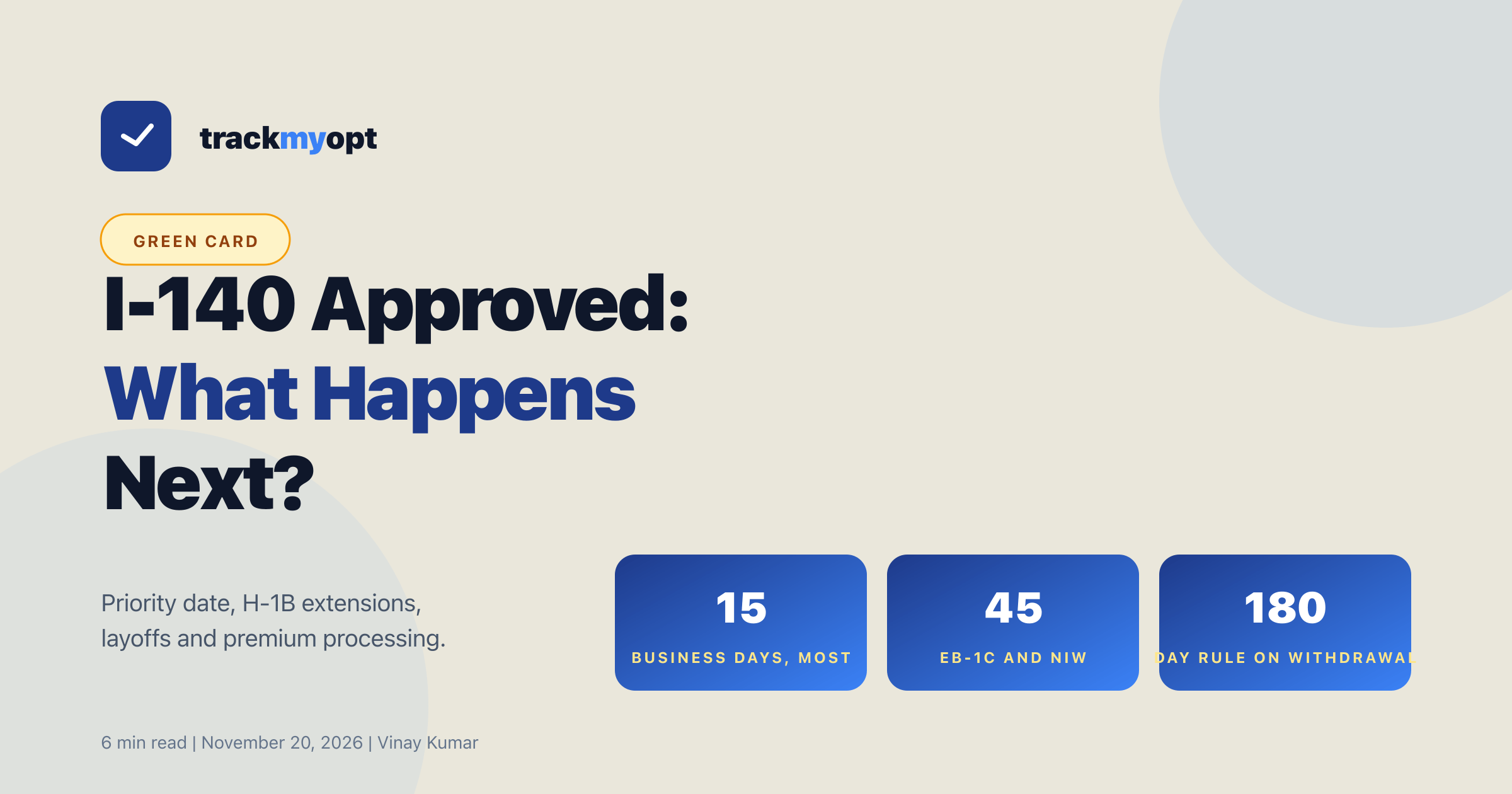
- Premium processing: 15 business days for most categories, 45 for EB-1C and NIW. The fee is $2,965.
What approval gives you
The I-140 is the petition step. USCIS agreed that you, the job and the employer fit an employment-based category.
| It does | It does not |
|---|---|
| Lock your priority date. | Give you a green card. |
| Let you file Form I-485 once the date is current. | Authorize work. |
| Support H-1B extensions beyond six years. | Extend F-1 or OPT status. |
| Let an H-4 spouse apply for work authorization. | Move with you to a new employer. |
Sources: 8 CFR 204.5(d) and (e): priority dates and retention; 8 CFR 214.2(h): H-1B portability, extensions beyond six years, H-4 employment
The next step: your priority date
For a case with a labor certification, the priority date is the day the Department of Labor accepted the PERM application. For categories without one, it is the day USCIS received the I-140.
Each month the Visa Bulletin lists cut-off dates by category and country. When your date is earlier than the cut-off, you can file Form I-485 in the United States or finish at a consulate.
For people born in India or China the wait can be many years. For most other countries it is much shorter.
Sources: 8 CFR 204.5(d) and (e): priority dates and retention; Visa Bulletin
What it unlocks while you wait
Two benefits matter most to H-1B families.

Sources: 8 CFR 214.2(h): H-1B portability, extensions beyond six years, H-4 employment
- H-1B beyond six years: if your I-140 is approved and a visa number is not available because of the per-country limit, USCIS may grant H-1B extensions in steps of up to three years.
- H-4 work authorization: the H-4 spouse of an H-1B worker with an approved I-140 may apply for an EAD on Form I-765.
Vinay’s practical note
If you are still on F-1 or OPT, be careful with travel. An approved I-140 shows an intent to immigrate, which can matter when you renew an F-1 visa or reenter. Ask an immigration attorney before you travel.
Laid off or changing jobs after approval
The priority date is yours. The regulation lets you keep it for any later EB-1, EB-2 or EB-3 petition, unless USCIS revokes the approval for fraud, a revoked or invalid labor certification, or a material error.
The petition belongs to the employer. A new employer normally starts again with a new PERM and a new I-140, and you carry the old priority date over.
| Event | Effect on the I-140 | Priority date |
|---|---|---|
| Employer withdraws it less than 180 days after approval | Revoked automatically | Kept for a later petition |
| Employer withdraws it 180 days or more after approval | Stays approved | Kept |
| Employer closes 180 days or more after approval | Stays approved | Kept |
| Revoked for fraud, labor certification problems or material error | Revoked | Lost |
Sources: 8 CFR 204.5(d) and (e): priority dates and retention; 8 CFR 205.1: automatic revocation and the 180-day rule; 8 CFR 214.2(h): H-1B portability, extensions beyond six years, H-4 employment
Vinay’s practical note
An I-140 that stays approved can still support H-1B extensions beyond six years. It does not replace the job offer you need to file Form I-485.
I-140 premium processing time
The employer, or you in a self-petition, can pay for premium processing with Form I-907. USCIS must approve, deny, or ask for more evidence within the period. A request for evidence starts a new period when USCIS gets your answer.
| Category | Period | Fee |
|---|---|---|
| EB-1A, EB-1B, EB-2 without a waiver, EB-3 | 15 business days | $2,965 |
| EB-1C multinational manager | 45 business days | $2,965 |
| EB-2 national interest waiver | 45 business days | $2,965 |
Sources: Form I-907, Request for Premium Processing Service
Vinay’s practical note
Premium processing speeds up the I-140 decision only. It does not move your priority date.
Your Action Checklist
Common Mistakes to Avoid
- Treating the approval as work authorization.
- Assuming the I-140 moves to a new employer.
- Leaving a job before 180 days without asking what happens to the petition.
- Travelling on an F-1 visa after approval without legal advice.
Track your I-140 or I-485 status
Save your receipt number and check your status free. Pro adds daily USCIS checks and email alerts when it changes.
Also see USCIS case status tracker features
Frequently Asked Questions
What happens after my I-140 is approved?
You wait for your priority date to become current in the Visa Bulletin. Then you file Form I-485 or complete consular processing.
How long after I-140 approval do I get a green card?
It depends on your category and country of birth. Most countries wait months to a few years. India and China can wait many years.
What if I am laid off after my I-140 is approved?
You keep the priority date for a later petition. If the I-140 was approved 180 days or more before the employer withdraws it, the petition itself stays approved.
Can my spouse work after my I-140 is approved?
If you hold H-1B status and your spouse holds H-4, your spouse may apply for an EAD once your I-140 is approved.
How long does I-140 premium processing take?
15 business days for most categories and 45 business days for EB-1C and national interest waiver cases. The fee is $2,965.
Does an approved I-140 let me stay after OPT ends?
No. It gives no status and no work authorization. You still need H-1B or another status until you can file Form I-485.
Official Sources
Rules can change. We checked this guide against the primary sources below; always open the current form instructions or agency page before acting.
- 8 CFR 204.5(d) and (e): priority dates and retention — eCFR
- 8 CFR 205.1: automatic revocation and the 180-day rule — eCFR
- 8 CFR 214.2(h): H-1B portability, extensions beyond six years, H-4 employment — eCFR
- Form I-907, Request for Premium Processing Service — USCIS
- Visa Bulletin — U.S. Department of State
Keep Reading
Written by Vinay Kumar
Vinay is a content writer at TrackMyOPT who specializes in immigration guidance for international students. All content is researched using official USCIS, SEVP, and Department of Labor sources and reviewed for accuracy by the TrackMyOPT team, which includes former F-1 students who navigated OPT, STEM OPT, and H-1B transitions firsthand.
Content Writer3,500+ Users Signed Up